For laboratory and research purposes only. Not for human or veterinary use.
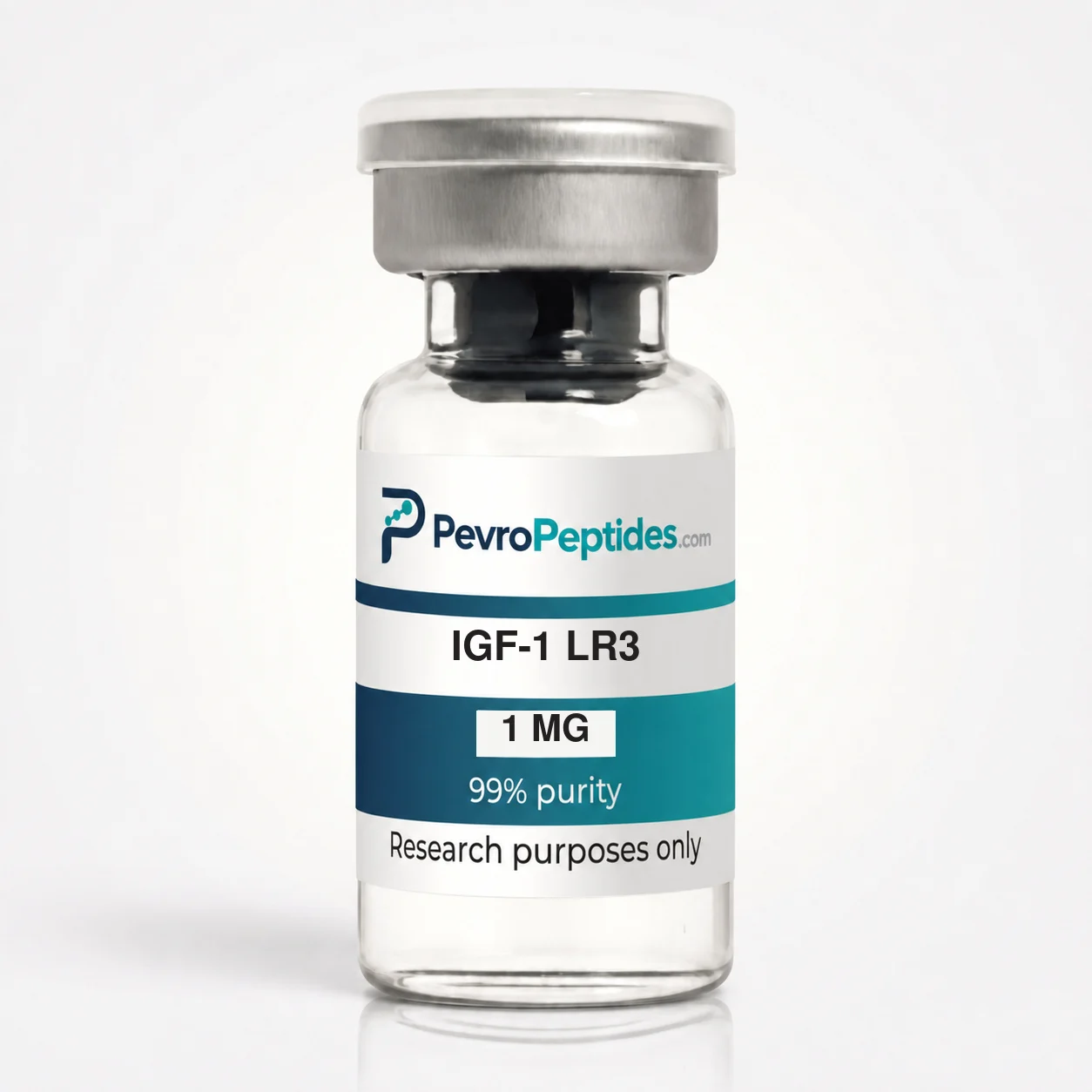
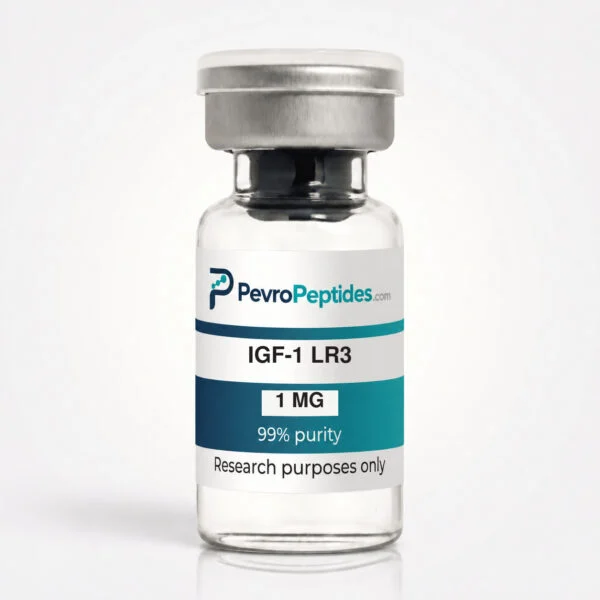
IGF-1 LR3 is a recombinantly produced protein analog with a modified chain structure, which is studied in controlled laboratory environments within the context of peptide-mediated signaling pathways and molecular regulatory systems. In scientific research, the compound is used as a model compound and as a reference standard in analytical work on longer polypeptide chains. This compound is offered as a freeze-dried lyophilisate in a sealed 1 mg research vial.
What is IGF-1 LR3?
IGF-1 LR3 is a single, non-glycosylated polypeptide chain of 83 amino acids, structurally derived from insulin-like growth factor 1 (IGF-1). The chain differs from it at two defined points: at position 3, an arginine residue is present instead of a glutamic acid residue, and an extension of thirteen amino acids has been added to the N-terminus. Both modifications alter the charge distribution and spatial structure of the N-terminal domain; the core stabilized by three disulfide bridges remains intact.
In research models, IGF-1 LR3 is studied in relation to receptor interaction modeling and signal transduction in cell models. The target described in the literature is the IGF-1 receptor (IGF1R); additionally, a significantly reduced affinity for binding carrier proteins (IGFBPs) is described, associated with the altered N-terminal structure. Consequently, IGF-1 LR3 is used as a model compound and reference substance within scientific research.
Research areas
In a laboratory context, IGF-1 LR3 occurs in the following research areas, among others:
- Receptor interaction modeling and research into the binding geometry of protein analogs to the described receptor domain.
- Studies of peptide-mediated signaling pathways and molecular regulatory networks in controlled cell models in vitro.
- Structure-activity relationship study into the contribution of individual amino acid substitutions to binding behavior.
- Research into protein-protein interactions, in particular the affinity of analogs for binding carrier proteins.
- Conformation and stability studies of longer polypeptide chains: folding, disulfide integrity, and proteolytic degradation profiles in vitro.
- Analytical method development and validation (HPLC, LC-MS, SDS-PAGE) using IGF-1 LR3 as the reference standard.
Each of these applications involves controlled laboratory or preclinical model research.
Analytical specification
The material is submitted with a controlled purity of ≥ 99%, determined via high-pressure liquid chromatography (HPLC). For proteins of this chain length, identity and purity are decisive: in addition to classical impurities, related variants can arise — truncated chains, misfolded forms, or oxidized residues — which are close in mass to the target molecule and directly influence the interpretation of binding and structure measurements. An overview of the available analysis documentation can be found on our lab results page.
Specifications
| Specification | Value |
|---|
| Sample | IGF-1 LR3 |
| Synonyms | Lung R3-IGF-1; Lung arginine 3-IGF-1; LR3-IGF-1 |
| Supply chain structure | 83 amino acids; arginine instead of glutamic acid at position 3; N-terminal extension of 13 amino acids |
| CAS number | 143045-27-6 (also registered as 946870-92-4) |
| Molecular weight | ± 9,117.6 Da |
| Class | Recombinantly produced protein analog; single, non-glycosylated polypeptide chain |
| Form | Freeze-dried lyophilisate in sealed vial |
| Quantity per vial | 1 mg |
| Purity | ≥ 99% (HPLC) |
| Storage | Store in a cool, dark place, protected from light and moisture. |
Shape, handling and storage
IGF-1 LR3 is supplied as freeze-dried lyophilisate in a sealed vial containing 1 mg of material. It presents as a white to off-white powder or a compact cake; both are a normal result of the freeze-drying process. This process preserves the molecular integrity of the polypeptide chain during storage and transport. Reconstitution applies and is carried out according to the protocol of the performing laboratory.
Store the sealed lyophilisate in a cool, dry, and dark place in the original packaging; for long-term storage, freeze temperature applies. Limit the number of freeze-thaw cycles, which can compromise the integrity of longer chains. Adhere to standard laboratory precautions: clean working environment, suitable protective equipment, no cross-contamination, and out of reach of unauthorized persons. Dispose of residual material in accordance with applicable laboratory guidelines.
IGF-1 LR3 in our research range
IGF-1 LR3 falls under the category of freeze-dried investigation compounds in vial form within our range. Researchers in this category frequently combine the compound with materials being studied via their own molecular target. While IGF-1 LR3 distinguishes itself by its chain length and a defined receptor-linked target, other components of the same product line have been selected to cover shorter sequences, metal-linked coordination, or enzymatic targets. These materials share the freeze-dried vial form but differ in molecular class and investigated mechanism.
Frequently Asked Questions
To which substance class does IGF-1 LR3 belong?
A recombinantly produced protein analog: a single, non-glycosylated polypeptide chain of 83 amino acids, belonging to the modified analogs of insulin-like growth factor 1.
Why are the structural modifications relevant in research?
The chain deviates from the basic structure at exactly two points: one substitution at position 3 and an N-terminal extension. This makes it useful for modeling the contribution of individual structural elements to binding behavior.
In what form is the connection supplied?
As freeze-dried lyophilisate in a sealed vial containing 1 mg of material, with a purity of ≥ 99% (HPLC).
What color and texture does the material have?
A white to off-white powder or a compact cake. Both are normal and do not indicate quality or defect.
How do I store the material?
Store in a cool, dry, and dark place in the original packaging. For long-term storage, keep at freezing temperature; limit the number of freeze-thaw cycles.

















 Pick up from the Woodmart Store
 Courier delivery
 DHL Courier delivery


 Overview

Reviews
There are no reviews yet.