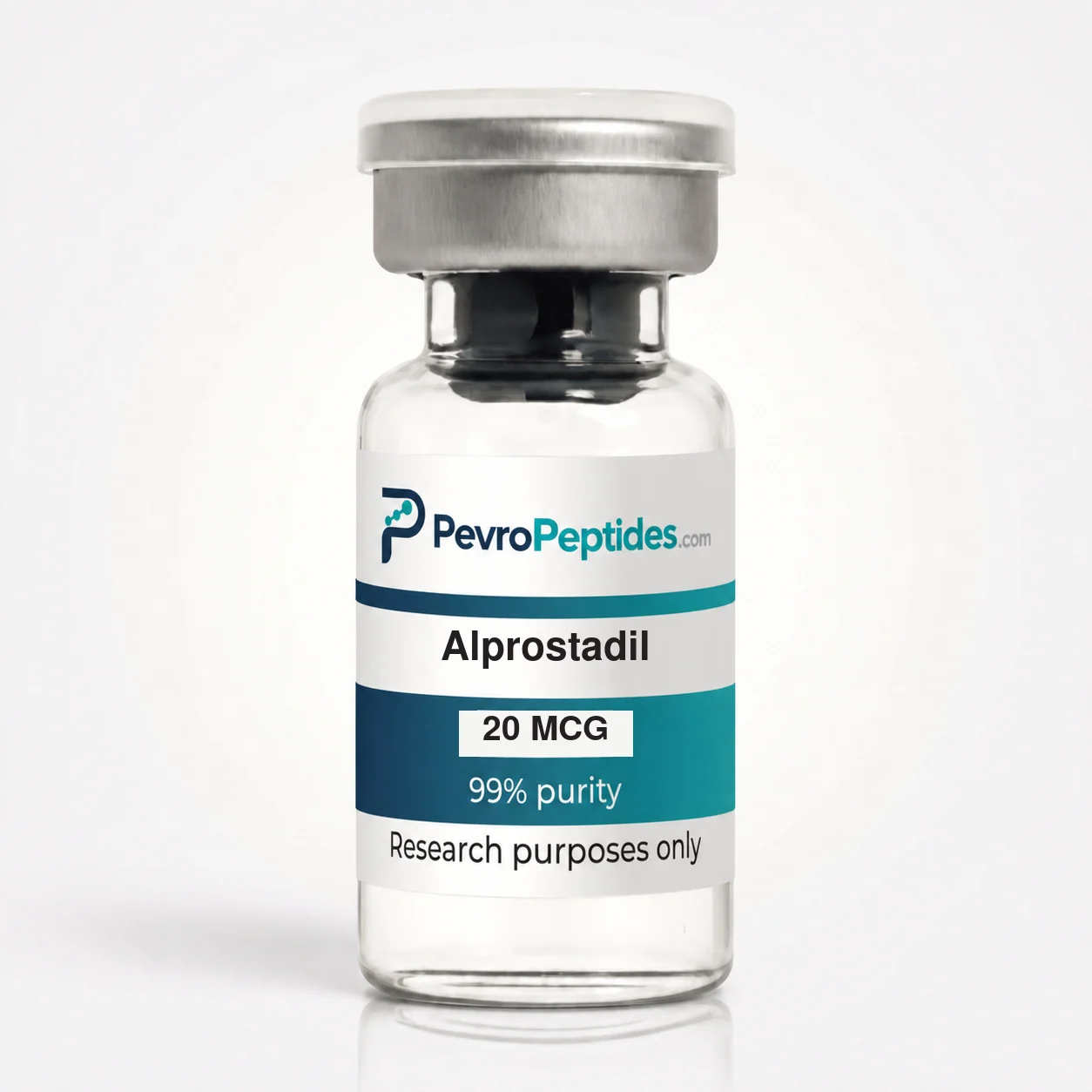
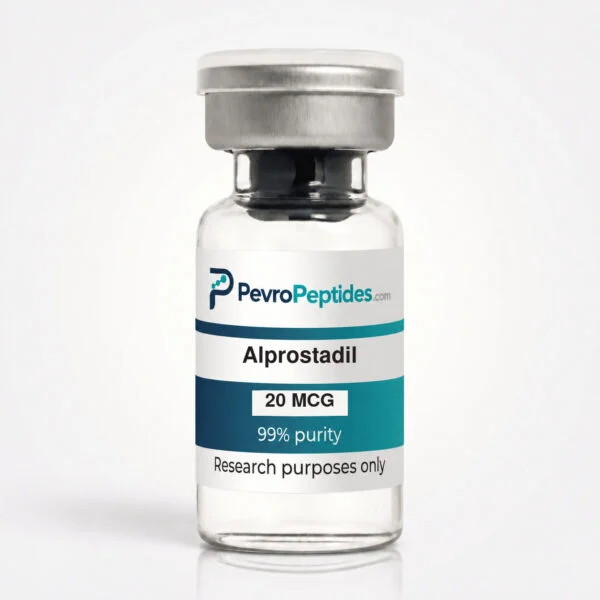
Alprostadil is an eicosanoid, chemically the synthetic form of prostaglandin E.1: a C20-carboxylic acid with a substituted cyclopentanone ring. Within scientific research, it is studied as a model compound for prostanoid receptors and eicosanoid chemistry and as a reference standard in analytical work. This compound is offered as a freeze-dried powder of 20 mcg per sealed vial, exclusively for laboratory and research purposes.
What is Alprostadil?
Alprostadil, systematic (13E,15S)-11α,15-dihydroxy-9-oxoprost-13-enoic acid, is composed of a five-membered ring with a ketone group at position 9 and two long side chains: a saturated chain with a terminal carboxylic acid group and a chain with one trans-double bond and a hydroxyl group in the S-configuration at position 15. The compound is distinct from prostaglandin E2 due to the absence of the double bond between C5 and C6: one structural difference, making the molecule suitable for investigating the influence of side-chain unsaturation on receptor recognition. Chemically, it is a labile molecule: the combination of a β-hydroxyketone in the ring and an allylic hydroxyl group makes the structure susceptible to water loss and isomerization, successively producing prostaglandin A1 and the conjugated prostaglandin B1 arise. Consequently, the compound serves as a classic model in stability studies of prostanoids.
In research models, prostaglandin E intervenes1 It attaches to the EP receptor family: four G-protein-coupled subtypes (EP1 to EP4) that activate diverse pathways, including cAMP enhancement via Gs and calcium mobilization via Gq. This makes the compound a common reference ligand for mapping subtype selectivity. Enzymatically, the 15-hydroxyl group is oxidized to a keto group by 15-hydroxyprostaglandin dehydrogenase, which significantly reduces affinity; this rapid conversion makes the substance attractive for enzymological research. Consequently, Alprostadil is used as a model compound and reference substance in scientific research.
Research areas
In a laboratory context, Alprostadil occurs in the following research areas, among others:
- Binding studies of the EP1 to EP4 subtypes in cell lines and membrane preparations in vitro.
- Research into signal transduction: cAMP formation and calcium mobilization after receptor activation in cell models.
- Enzymological investigation of 15-hydroxyprostaglandin dehydrogenase and the oxidation of the 15-hydroxyl group.
- Model research into vascular tone in isolated tissue preparations, with the compound as a comparison standard.
- Structure-activity research within the prostanoids, focusing on the stereochemistry at positions 11 and 15.
- Stability studies regarding water separation and isomerization, and analytical method development using LC-MS/MS, are necessary because the molecule itself exhibits hardly any UV absorption.
Each of these applications involves controlled laboratory or preclinical model research.
Alprostadil in our research assortment
Alprostadil falls under the category of freeze-dried research compounds in sealed vials within our product range. While Alprostadil is a lipid signaling molecule that targets prostanoid receptors, other components within the same product line focus on peptide chains or enzymatic targets. They share the freeze-dried form and associated storage requirements, but differ fundamentally in molecular class and investigated mechanism.
Specifications
| Specification |
Value |
| Sample |
Alprostadil |
| Synonyms |
Prostaglandin E1; PGE1; (13E,15S)-11α,15-dihydroxy-9-oxoprost-13-enoic acid |
| CAS number |
745-65-3 |
| Molecular formula / weight |
C20H34O5 / 354.5 Da |
| PubChem CID |
5280723 |
| Class |
Eicosanoid, prostaglandin; ligand of the EP receptor family |
| Form |
Freeze-dried powder (lyophilisate) |
| Quantity per vial |
20 mcg |
| Storage |
Store freeze-dried in a cool, dark place; use refrigerated and for a short period when in solution. |
Shape, handling and storage
Alprostadil is supplied as a freeze-dried powder in a sealed vial with 20 mcg per unit. The lyophilisate is a solid, fine mass that is only dissolved in the laboratory setup, according to the laboratory's own procedure; in analytical work, prostaglandins are usually dissolved in ethanol or a similar organic medium, because aqueous solutions accelerate chemical degradation.
Store the unopened vial in a cool, dry, and dark place in the original packaging; the structure is sensitive to heat, moisture, and non-neutral acidity. Handle the material with standard laboratory precautions: work in a clean environment, use appropriate personal protective equipment, and prevent cross-contamination with other research materials. Keep the packaging out of reach of unauthorized persons.
Composition and lab results
The material in the vial is the freeze-dried compound with a controlled purity of ≥ 99% (HPLC). For this class of substances, chromatographic separation also reveals the dehydration and isomerization products that arise during improper storage.
You can find an overview of the available analytical documentation on our lab results pageThe reports are collected centrally there, so that you can incorporate the data into your own research records.
Frequently Asked Questions
To which class of substances does Alprostadil belong?
Alprostadil is an eicosanoid: a lipid signaling molecule with twenty carbon atoms from the prostaglandin family. It is not a peptide and therefore contains no amino acid sequence.
What happens to the 15-hydroxyl group in research models?
That group is oxidized to a keto group by 15-hydroxyprostaglandin dehydrogenase. The resulting 15-keto product binds much more weakly to the EP receptors, making this step central to mechanistic research on prostanoids.
In what form is the compound supplied?
As freeze-dried powder in a sealed vial, with 20 mcg per vial.
How do I store the vial?
Cool, dry, and dark, in the original packaging. The freeze-dried powder is significantly more stable than a solution; solutions are stored refrigerated and preferably used shortly after preparation.

















 Pick up from the Woodmart Store
 Courier delivery
 DHL Courier delivery



Reviews
There are no reviews yet.