Uitsluitend voor laboratorium- en onderzoeksdoeleinden. Niet voor menselijk of veterinair gebruik.
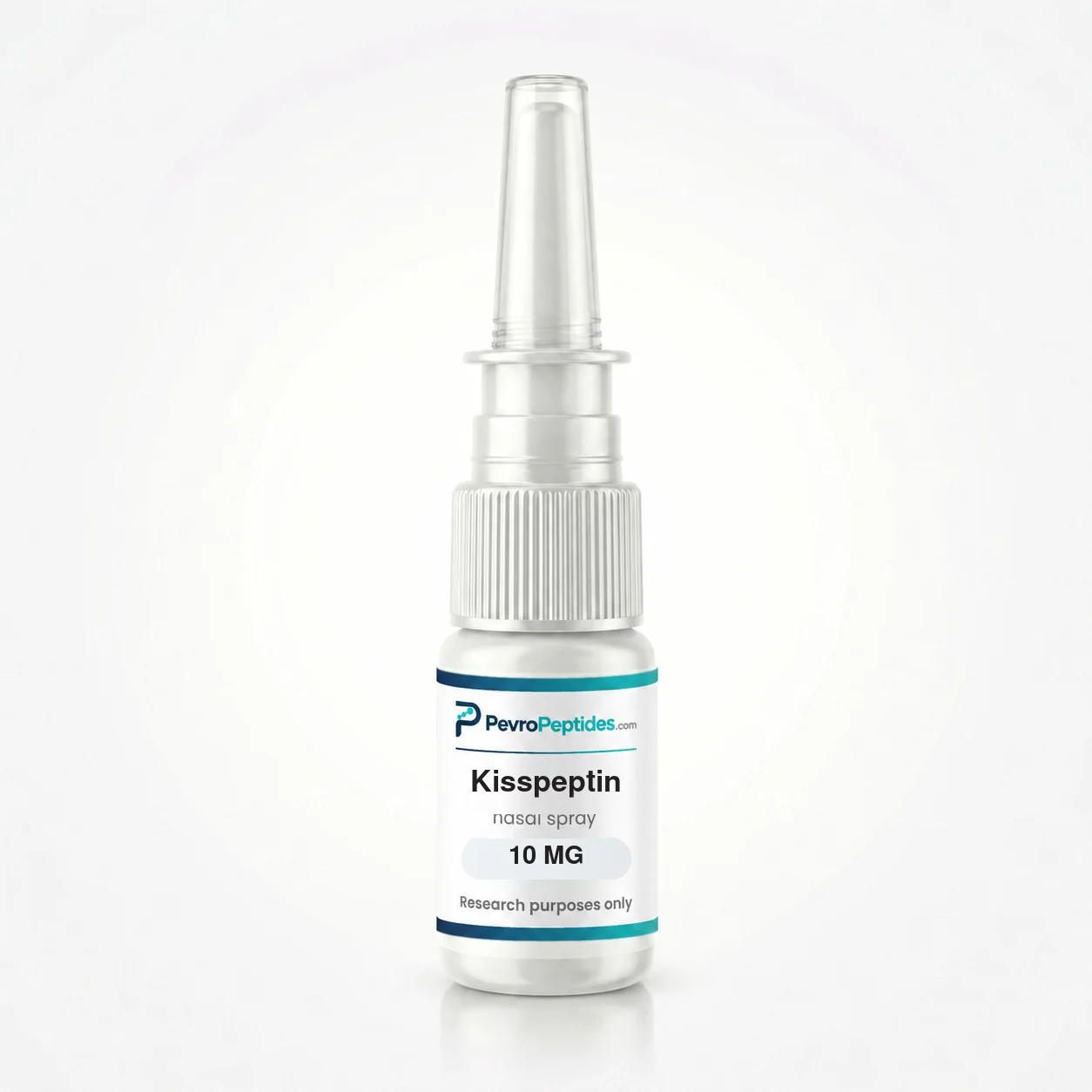
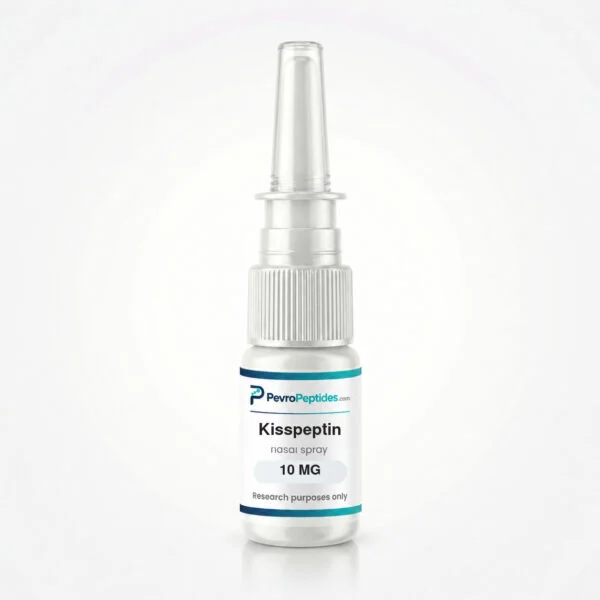
Kisspeptin-10 is a synthetic RF amide decapeptide that is studied in controlled laboratory settings within the framework of peptide-mediated signaling pathways and receptor interaction modeling. In scientific research, the compound is used as a model compound and as a reference standard in analytical work. The material is offered as freeze-dried lyophilisate in a sealed 10 mg research vial, supplied as a set with a sterile physiological saline solution and an empty spray bottle.
What is Kisspeptin-10?
Kisspeptin-10 is a decapeptide with the amino acid sequence Tyr-Asn-Trp-Asn-Ser-Phe-Gly-Leu-Arg-Phe-NH2 (YNWNSFGLRF-NH2). It concerns the C-terminal fragment of kisspeptin-54 and is the shortest fragment within this peptide family that contains the complete structural determinants for receptor recognition. Characteristic is the C-terminal amidation of the final phenylalanine residue: that Arg-Phe-NH2The -motif places the compound in the class of RF-amide peptides and serves as the determining structural condition for affinity in binding studies. Additionally, the aromatic residues tryptophan, tyrosine, and phenylalanine give the molecule a well-characterizable UV profile.
In research models, kisspeptin-10 is described as a ligand of the KISS1R receptor, also referred to in the literature as GPR54: a G-protein-coupled receptor of class A. In cell models, the subsequent signal transduction is monitored in vitro via the Gq/11 pathway, involving activation of phospholipase C, conversion of phosphatidylinositol-4,5-bisphosphate into inositol triphosphate and diacylglycerol, and the associated intracellular calcium mobilization and activation of protein kinase C. Due to this defined behavior in receptor assays, the compound regularly serves as a reference input in comparative peptide studies. Consequently, kisspeptin-10 is used as a model compound and reference substance within scientific research.
Forschungsgebiete
In a laboratory context, Kisspeptin-10 occurs in the following research areas, among others:
- Receptor binding and affinity studies of KISS1R (GPR54) in controlled in vitro systems.
- Studies on peptide-mediated signaling pathways and molecular regulatory networks in cell models.
- Structure-activity relationship research on RF amide peptides and the contribution of individual amino acid residues to receptor recognition.
- Conformation and stability study in which the role of the C-terminal amidation ring for the peptide structure is modeled.
- Analytical method development and validation (HPLC, LC-MS, UV detection) using kisspeptin-10 as the reference standard.
- Comparative study within the class of neuropeptides with a G-protein-coupled molecular target.
Jede dieser Anwendungen beinhaltet kontrollierte Labor- oder präklinische Modellforschung.
Analytische specificatie
The material is submitted with a controlled purity of ≥ 99%, determined via high-pressure liquid chromatography (HPLC). Identity and purity are determining parameters in analytical peptide work: impurities or deamidated variants can influence the interpretation of measurement results, particularly for a peptide where the C-terminal amidation is central to the measurement. An overview of the available analysis documentation can be found on our Seite mit Laborergebnissen.
Spezifikationen
| Spezifikation |
Wert |
| Probe |
Kisspeptin-10 (human) |
| Synonyme |
KP-10; C-terminal decapeptide fragment of kisspeptin-54 |
| Sequenz |
Tyr-Asn-Trp-Asn-Ser-Phe-Gly-Leu-Arg-Phe-NH2 (YNWNSFGLRF-NH2) |
| CAS-Nummer |
374675-21-5 |
| PubChem CID |
25240297 |
| Molekularformel / Gewicht |
C63H83N17O14 / ± 1302.4 Da |
| Klasse |
Synthetic RF-amide-decapeptide |
| Form |
Gevriesdroogd lyofilisaat in verzegelde vial |
| Menge pro Einheit |
10 mg |
| Reinheit |
≥ 99% (HPLC) |
| Lagerung |
Gekoeld en donker bewaren, beschermd tegen licht en vocht |
Form, Handhabung und Lagerung
Kisspeptin-10 is supplied as freeze-dried lyophilisate in a sealed 10 mg vial. The lyophilization process preserves the molecular integrity of the peptide during storage and transport. The material typically has a white to off-white appearance. In addition to the vial, the set contains a sterile physiological saline solution and an empty spray bottle.
Store the sealed lyophilisate in a cool, dry, and dark place in the original packaging, protected from light and moisture. Freeze-dried peptides are hygroscopic: allow a cooled vial to reach room temperature before breaking the seal. Handle the compound with standard laboratory precautions: work in a clean environment, use appropriate personal protective equipment, and prevent cross-contamination. Dispose of residual material in accordance with applicable laboratory guidelines.
Kisspeptin-10 in our research assortment
Kisspeptin-10 falls under the category of freeze-dried investigational compounds in vial form within our product range. Researchers working with this category frequently combine the compound with other peptides studied via their own molecular target. While kisspeptin-10 distinguishes itself through interaction with a G-protein-coupled receptor and the RF-amide motif, other components within the same product line have been specifically chosen to cover enzymatic or metal-bound targets. These compounds share the freeze-dried vial form but differ fundamentally in molecular class and investigated mechanism.
Häufig gestellte Fragen
To which class of substances does Kisspeptin-10 belong?
Kisspeptin-10 is a synthetic decapeptide with a C-terminal Arg-Phe-NH2-motif and thus belongs to the class of RF-amide peptides.
Why is C-terminal amidation relevant in research?
The amide group at the final phenylalanine residue determines the affinity for the receptor model under investigation in binding studies and gives the molecule a defined, well-characterizable structure. As a result, the compound is useful as a model in receptor interaction research and as a reference in analytical methods.
What does the lyophilized material look like?
White to off-white, as a compact cake or as a fine powder. Both appearances are normal and are associated with the freeze-drying process.
In welcher Form wird die Verbindung geliefert?
Als gefriergetrocknetes Lyophilisat in einem versiegelten 10-mg-Fläschchen mit einer Reinheit von ≥ 99 % (HPLC).
Hoe bewaar ik het materiaal?
Store in a cool, dry, and dark place in the original packaging, protected from light and moisture.

















 Abholung im Woodmart-Laden
 Kurierzustellung
 DHL-Kurierdienst



Rezensionen
Es gibt noch keine Rezensionen.