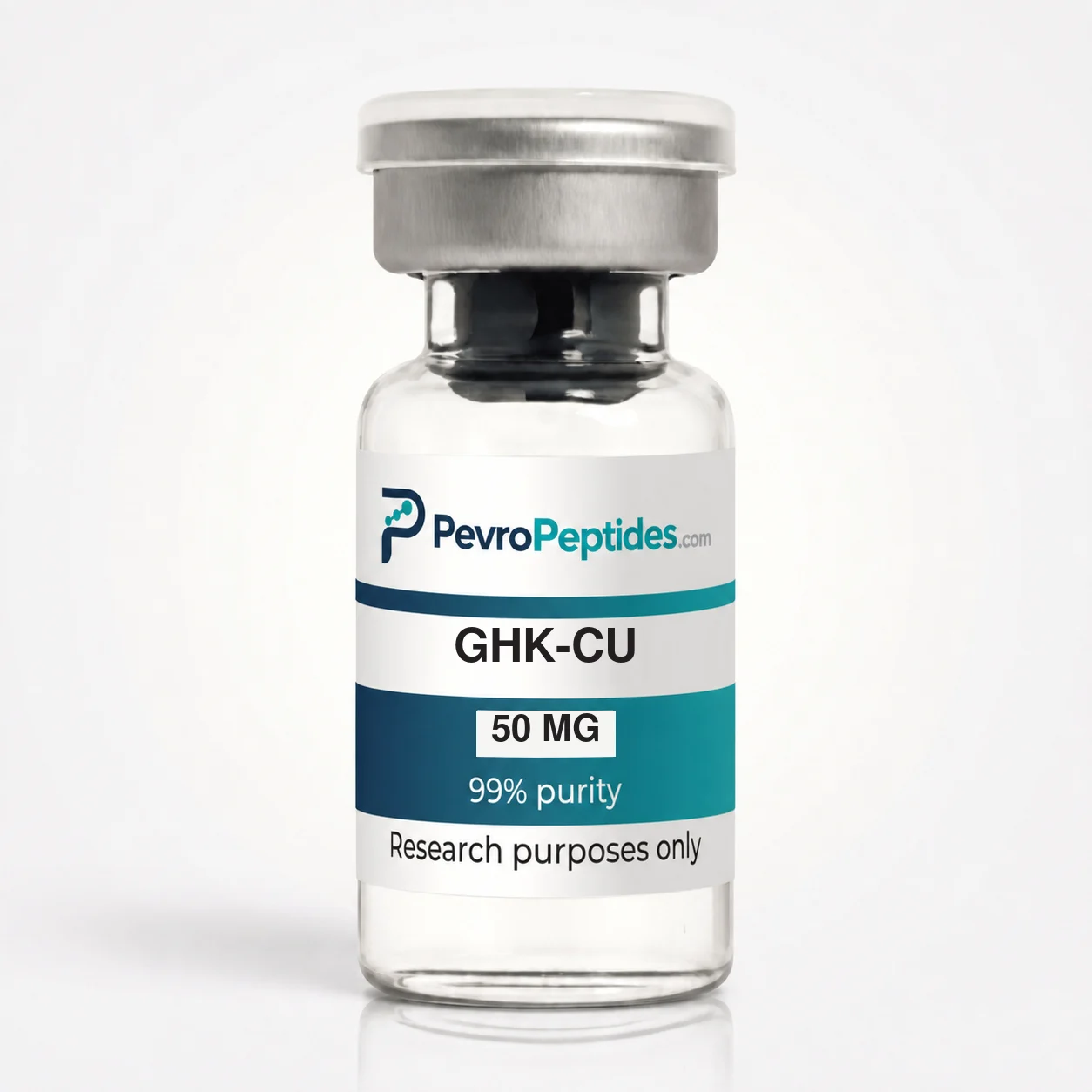
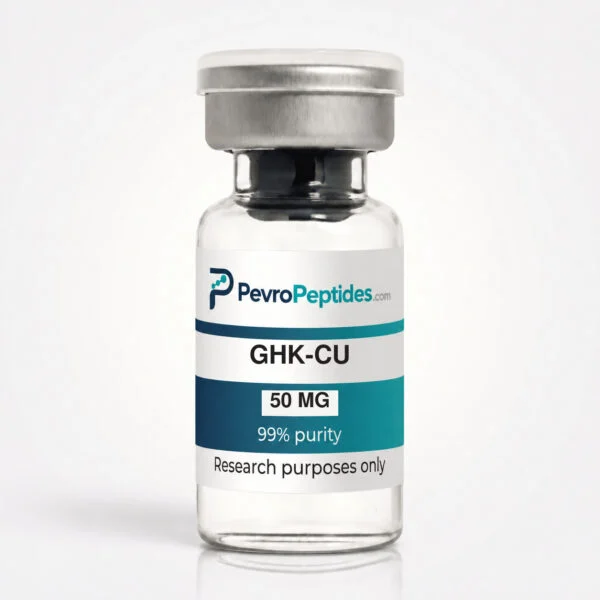
GHK-Cu is a copper-binding tripeptide complex, chemically a metallopeptide of glycyl-L-histidyl-L-lysine with a coordinated copper(II) ion. In scientific research, it is studied as a model compound for the coordination chemistry of peptide-metal complexes and as a reference standard in analytical work. This compound is offered as a freeze-dried powder of 50 mg per vial, exclusively for laboratory and research purposes.
What is GHK-Cu?
GHK-Cu is the copper(II) complex of the naturally occurring tripeptide GHK, with the amino acid sequence glycine-histidine-lysine (Gly-His-Lys). The metal ion is not loosely associated but fixed in a defined coordination pocket: the bonding mode is typically described as a planar arrangement of three nitrogen donors, namely the α-amino group of the N-terminal glycine, the deprotonated amide nitrogen atom of the first peptide bond, and the imidazole of the histidine. The basic lysine side chain remains outside this arrangement and keeps the complex highly water-soluble. Because this geometry is so sharply defined, GHK-Cu is considered a classic model system for copper binding to short peptides in bioinorganic chemistry.
In research models, the complex is primarily studied as an exchangeable copper reservoir: in vitro, under defined conditions, the coordinated ion can be transferred to competing ligands or to copper-dependent enzymes such as lysyl oxidase and superoxide dismutase, with which binding constants and exchange rates become comparable. Additionally, the copper(II) center makes the complex easy to track spectroscopically: alongside the UV absorption of the imidazole, a weak dd transition occurs in the visible region, which explains the characteristic blue color and allows for the measurement of complex formation or decomposition. Consequently, GHK-Cu is used as a model compound and reference substance within scientific research.
Research areas
In a laboratory context, GHK-Cu occurs in the following research areas, among others:
- Bioinorganic coordination chemistry: stability constants, stoichiometry and geometry of copper(II)-peptide complexes.
- Enzymological research into copper-dependent enzymes, including lysyl oxidase and superoxide dismutase, in cell-free systems.
- Structure-activity relationship study of tripeptides with histidine at position 2 and their copper affinity.
- Cell culture models for the conversion of components of the extracellular matrix into fibroblast cultures.
- Analytical method development and validation (HPLC, UV-vis, LC-MS) with GHK-Cu as the reference standard.
- Stability study of metallopeptides under controlled light, pH, and oxidation conditions.
Each of these applications involves controlled laboratory or preclinical model research.
GHK-Cu within our research assortment
Within our range, GHK-Cu falls under the category of freeze-dried research compounds in vial form, a category that researchers regularly combine with substances studied via their own biochemical target. While GHK-Cu focuses on metal coordination and the associated bioinorganic chemistry, other components within the same product line have been specifically chosen to cover receptor-linked or enzymatic targets. These compounds share the freeze-dried vial form but differ fundamentally in molecular class and investigated mechanism.
Specifications
| Specification |
Value |
| Sample |
GHK-Cu (glycyl-L-histidyl-L-lysine, copper(II) complex) |
| Synonyms |
copper tripeptide-1; Cu-GHK |
| Sequence |
Gly-His-Lys |
| CAS number |
89030-95-5 (copper(II) complex) 49557-75-7 (GHK peptide) |
| Molecular formula / weight (GHK peptide) |
C14H24N6O4 / 340.38 Da |
| PubChem CID |
378611 (Cu-GHK) 342538 (GHK) |
| Class |
Metallopeptide; copper(II) complex of a tripeptide |
| Form |
Freeze-dried powder (lyophilized powder) in sealed vial |
| Quantity per vial |
50 mg |
| Storage |
Store in a cool, dark place, protected from light and moisture. |
Shape, handling and storage
GHK-Cu is supplied as a freeze-dried powder of 50 mg per vial, sealed under a rubber stopper with aluminium sealing. The lyophilisate has the blue to blue-grey colour characteristic of copper(II) peptides; this is derived from the coordinated metal ion and is therefore inherent to the class of substances. In a laboratory setting, the material is weighed and further processed according to the applicable analytical protocol, where hygroscopic behaviour is a known point of attention.
Store the closed vial in a cool, dark place, protected from light and moisture, preferably in the original packaging; copper(II) complexes are sensitive to light and oxidative conditions. Handle the compound with standard laboratory precautions: work in a clean environment, use appropriate personal protective equipment, and prevent cross-contamination with other research materials. Keep the packaging out of reach of unauthorized persons.
Composition and lab results
The lyophilisate contains 50 mg GHK-Cu per vial with a controlled purity of ≥ 99% (HPLC). No bulking agents or stabilizers are added, so that the measured copper-peptide ratio is not distorted by excipients.
You can find an overview of the available analytical documentation on our lab results page, where the reports are centrally collected for your own research records.
Frequently Asked Questions
To which class of substances does GHK-Cu belong?
A metallopeptide: the tripeptide Gly-His-Lys with one coordinated copper(II) ion. Thus, neither a pure peptide nor an inorganic copper salt, but a complex of both.
What role does the copper ion play in the investigated mechanism?
It is held by the N-terminal amino group, the amide nitrogen atom of the first peptide bond, and the imidazole of the histidine. This geometry determines the binding strength and provides the dd absorption band for spectroscopic control.
In what form is the compound supplied?
As a freeze-dried, blue-coloured powder of 50 mg in a sealed vial, without added excipients.
How do I store the vial?
Cool and dark, protected from light and moisture, preferably unopened in the original packaging.

















 Pick up from the Woodmart Store
 Courier delivery
 DHL Courier delivery


 Overview

Reviews
There are no reviews yet.