Matrixyl is the well-known trade name for palmitoyl pentapeptide-4 (Pal-KTTKS), a lipidated pentapeptide belonging to the matrikines. The molecule consists of a short chain of five amino acids attached to a palmitoyl acid tail (a saturated 16-carbon chain). In scientific research, Matrixyl is studied in models involving collagen synthesis, fibroblasts, and the extracellular matrix. This product is offered exclusively for laboratory and research purposes.
What is Matrixyl?
Matrixyl belongs to the matrikines: peptide fragments derived from proteins in the extracellular matrix that function as signaling molecules in research models. The active core is the sequence KTTKS (lysine-threonine-threonine-lysine-serine), a fragment corresponding to part of the propeptide of collagen type I. Linking this fragment to palmitoylic acid creates a lipophilic molecule that is handled differently in model systems than the free peptide, making it a widely studied subject in formulation and penetration research.
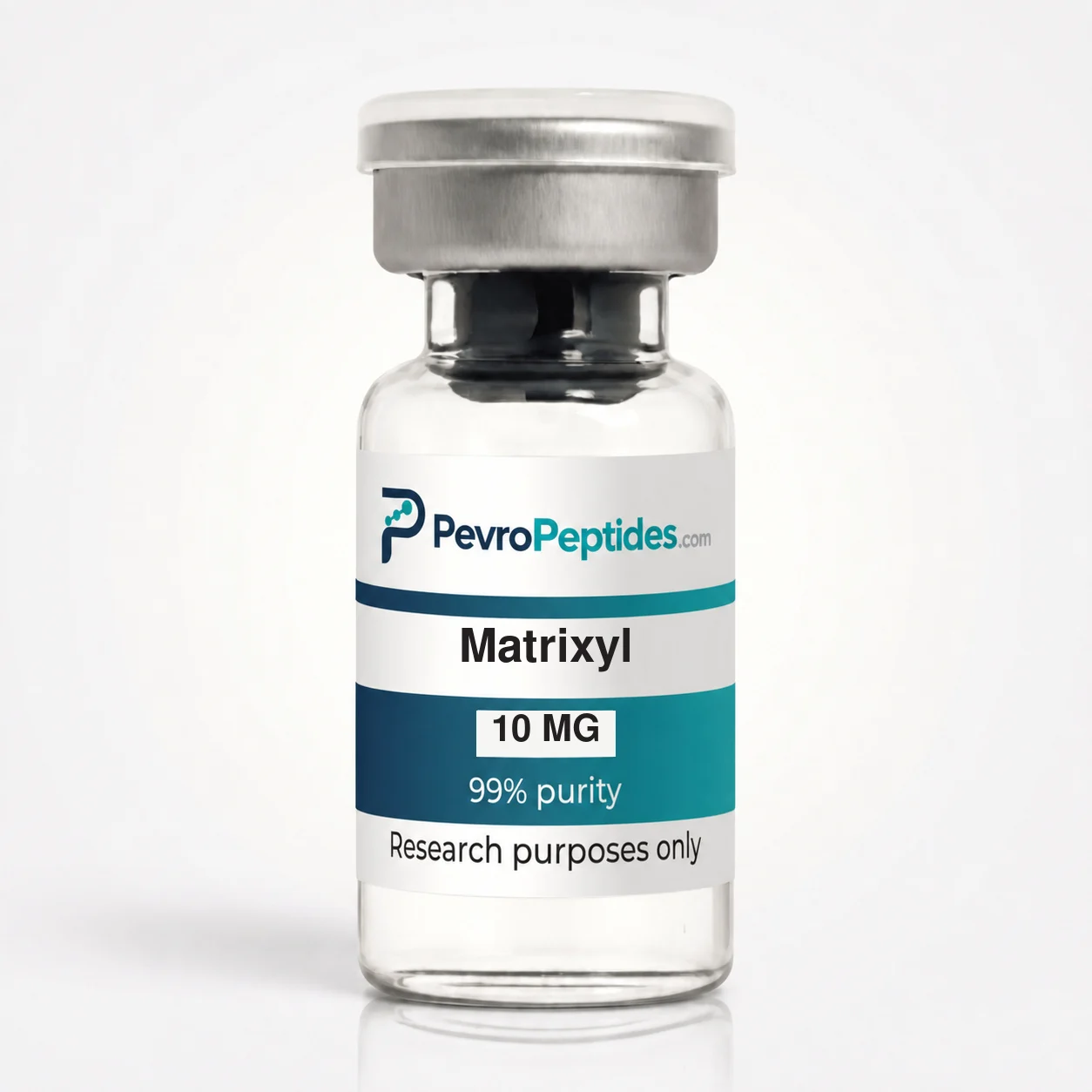
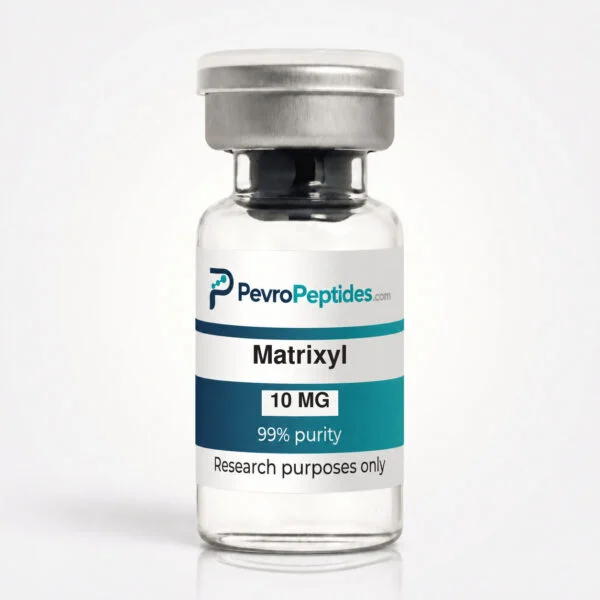
The compound was originally designated as palmitoyl-pentapeptide-3 and was later renamed palmitoyl-pentapeptide-4. At Lumo Peptides, Matrixyl is supplied as lyophilisate (freeze-dried powder) of 10 mg per vial. It is intended as reference material for in vitro and preclinical laboratory work and not for any form of consumption or use in humans or animals.
Forschungsgebiete
In scientific literature and laboratory designs, palmitoyl-pentapeptide-4 appears in diverse research contexts. Examples of areas in which this type of molecule is studied:
- Research into collagen synthesis and the role of matrikins in fibroblast cell models;
- Study of the extracellular matrix, including components such as fibronectin and glycosaminoglycans;
- Research into peptide penetration and the effect of lipophilic modification (palmitoylation) in in vitro skin models;
- Comparative study with other signal and copper peptides;
- Formulation research into the stability and solubility of lipidated peptides;
- Structure-activity research of KTTKS and other short peptide fragments.
Matrixyl compared with related compounds
Matrixyl is often placed alongside other peptides in research that are studied in skin- and matrix-related models. A well-known neighboring category is the copper peptides, such as GHK-Cu, a tripeptide-copper complex that also recurs in collagen and extracellular matrix research. A related copper compound is AHK-Cu, which is investigated in similar models. Where Matrixyl is a lipidated pentapeptide, is SNAP-8 an acetyl-octapeptide that is studied via a completely different mechanism; the comparison between such signal peptides is itself a subject of research. Coordinating these compounds helps researchers relate the structure, length, and modification of peptides to their behavior in model systems.
Möchten Sie mehr erfahren? Lesen Sie unseren Leitfaden: Copper peptide (GHK-Cu): what it is, the forms and how to use them.
Spezifikationen
| Spezifikation |
Wert |
| Probe |
Matrixyl (Palmitoyl Pentapeptide-4) |
| Klasse |
Lipidated pentapeptide (matrikine) |
| Synonyme |
Matrixyl, Palmitoyl Pentapeptide-3 (old name), Pal-KTTKS |
| CAS-Nummer |
214047-00-4 |
| Molekularformel / Gewicht |
C39H75N7O10 / 802.05 g/mol |
| PubChem CID |
9897237 |
| Sequenz |
Pal-Lys-Thr-Thr-Lys-Ser (Pal-KTTKS) |
| Form |
Lyophilized powder (dry powder), 10 mg per vial |
| Reinheit |
≥ 99 % (HPLC) |
| Lagerung |
Gekühlt lagern, vor Licht und Feuchtigkeit schützen. |
Form, Handhabung und Lagerung
Matrixyl is supplied as a freeze-dried powder in a sealed vial containing 10 mg of peptide. For laboratory use, the lyophilisate is reconstituted into a solution; bacteriostatic water is typically used as a solvent in a research context. Lipid peptides such as palmitoyl pentapeptide-4 are less soluble than fully hydrophilic peptides, which is a point of attention when preparing samples.
The unopened vial remains most stable when stored refrigerated, dry, and dark. After reconstitution, the solution should be stored refrigerated and used within a limited period; repeated freezing and thawing are avoided in laboratory practice to limit degradation. In all handling, adhere to standard laboratory safety and the aseptic procedure appropriate to the specific investigation.
Reinheit und Laborergebnisse
Our peptides are offered with a controlled purity of ≥ 99%, determined via HPLC. We do not make statements regarding specific individual analyses on this product page; an overview of available lab results can be found on our Seite mit LaborergebnissenThis way, the information on the product page remains general and verifiable.
Häufig gestellte Fragen
What is the difference between Matrixyl and palmitoyl-pentapeptide-3?
It concerns the same class of substances: the compound formerly known as palmitoyl-pentapeptide-3 is referred to as palmitoyl-pentapeptide-4 since the renaming. Matrixyl is the common trade name.
Why is Matrixyl linked to a palmitoyl chain?
The palmitoylic acid tail makes the originally hydrophilic KTTKS fragment more lipophilic. This is relevant in research because lipophilicity influences how a peptide behaves in model systems and membranes; it is a widely studied example of a modified peptide.
How is Matrixyl solved in the lab?
The lyophilisate is reconstituted with a suitable solvent; in a research context, this is usually bacteriostatic water. Due to the lipophilic modification, complete dissolution may require somewhat more attention than with hydrophilic peptides.
How do I store this product?
Store unopened in a cool, dry, and dark place. Keep the reconstituted solution refrigerated and avoid repeated thawing and defrosting.
Ausschließlich für Labor- und Forschungszwecke bestimmt. Nicht zum Verzehr durch Mensch oder Tier oder für medizinische, diagnostische, therapeutische oder kosmetische Zwecke. Der Käufer ist mindestens 18 Jahre alt und bestätigt den Forschungskontext. Kein Arzneimittel.

















 Abholung im Woodmart-Laden
 Kurierzustellung
 DHL-Kurierdienst



Rezensionen
Es gibt noch keine Rezensionen.