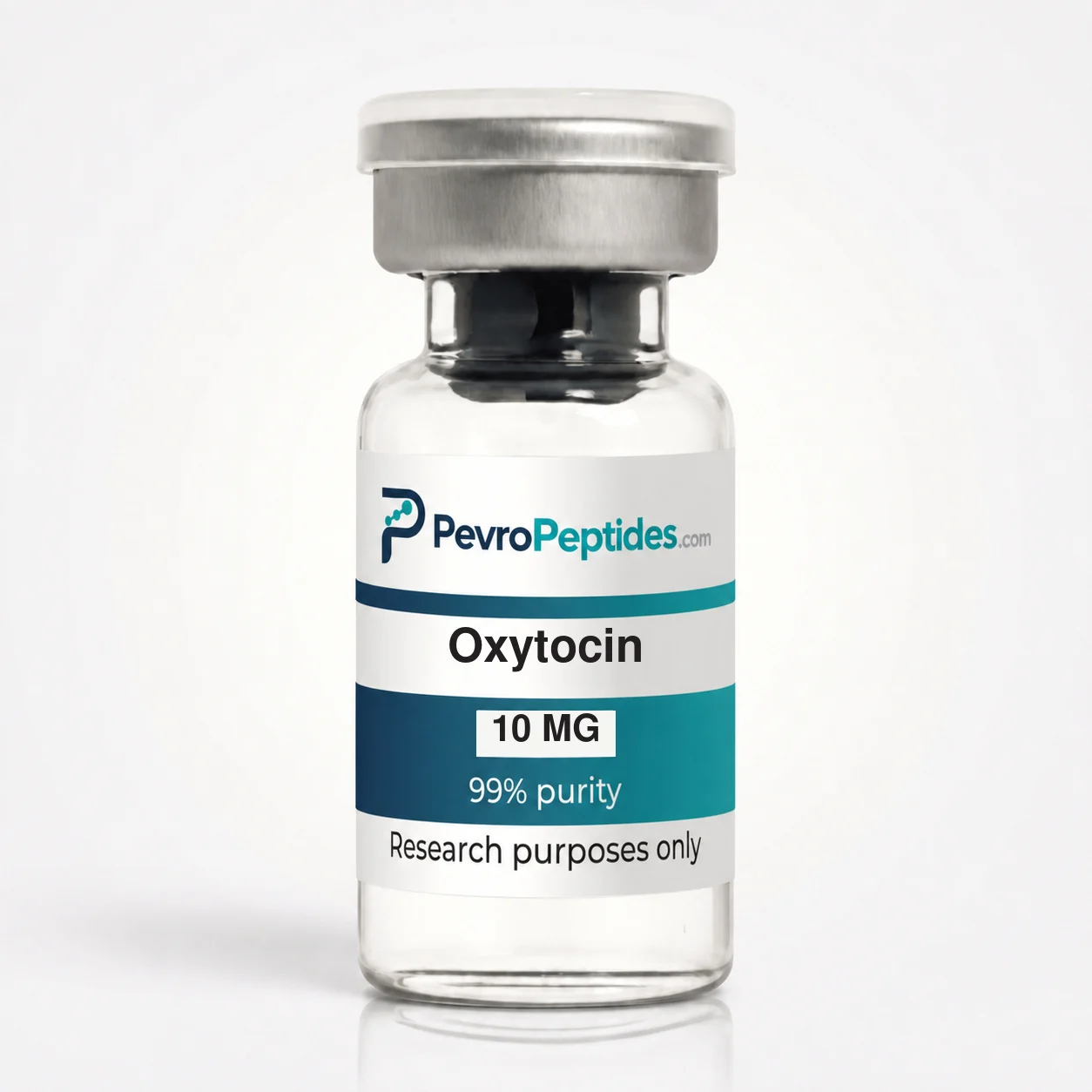
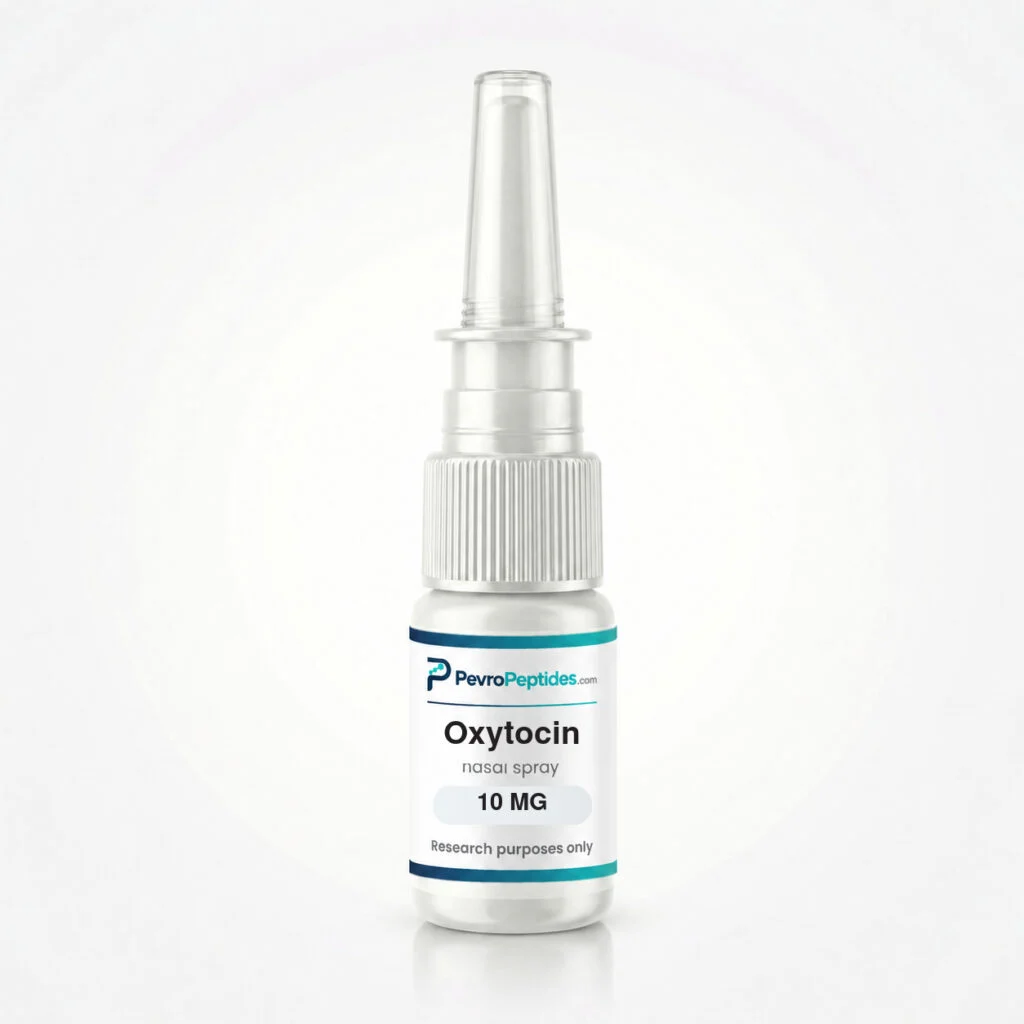
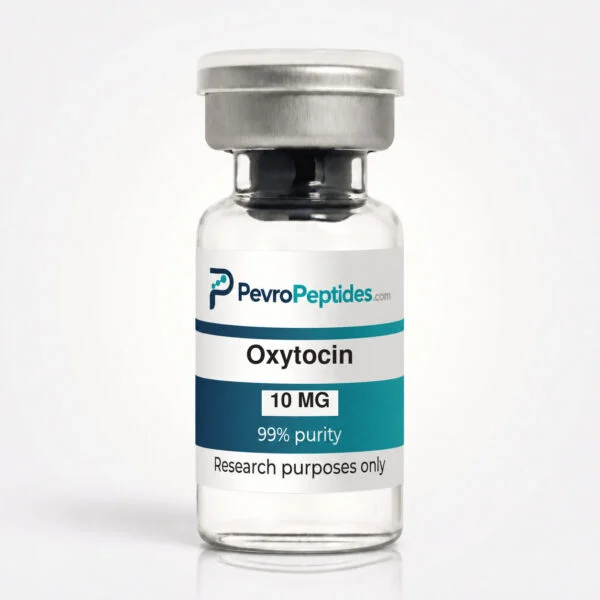
Oxytocin is an endogenous nonapeptide belonging to the family of neurohypophyseal peptide hormones; chemically, it is a cyclic peptide with an intramolecular disulfide bridge. In scientific research, it is studied as a model compound for receptor pharmacology and peptide chemistry and as a reference standard in analytical work. This compound is offered as a freeze-dried powder of 10 mg per vial, exclusively for laboratory and research purposes.
What is Oxytocin?
Oxytocin is a peptide of nine amino acids with the sequence Cys-Tyr-Ile-Gln-Asn-Cys-Pro-Leu-Gly-NH2The cysteine residues at positions 1 and 6 form a disulfide bridge, causing the molecule to carry a closed ring of six amino acids with a tail of three residues and an amidated C-terminus. This combination of a fixed ring and a flexible tail makes the compound a widely used model in the study of peptide receptor recognition.
In research models, oxytocin binds to the oxytocin receptor (OXTR), a rhodopsin-like class A receptor with seven transmembrane domains. In vitro, this receptor primarily couples to G proteins of the Gq/11-type, after which phospholipase C forms the membrane lipid PIP2 It splits into inositol triphosphate and diacylglycerol; the former initiates the release of intracellular calcium in cell models, while the latter activates protein kinase C. Because Oxytocin differs from the related nonapeptides of the same hormone family at only two positions, it also exhibits weaker cross-reactivity with related receptor subtypes in cell culture systems. Consequently, Oxytocin is used as a model compound and reference substance in scientific research.
Domenii de cercetare
In a laboratory context, Oxytocin occurs in the following research areas, among others:
- Receptor binding studies of the oxytocin receptor (OXTR) and the affinity of cyclic nonapeptides for class A receptors in vitro.
- Research into Gq/11-coupled signal transduction, phospholipase C activity and calcium mobilization in isolated cell models.
- Structure-activity analysis in which disulfidation and individual residues are systematically varied.
- Biophysical model studies (NMR, circular dichroism) of the spatial structure of cyclic peptides.
- Analytical method development and validation (HPLC, LC-MS) using Oxytocin as the reference standard.
- Stability and solubility studies of disulfide-containing peptides under controlled temperature and pH conditions.
Fiecare dintre aceste aplicații implică cercetare controlată de laborator sau pe modele preclinice.
Oxytocin in our research range
Oxytocin falls under the category of freeze-dried investigational peptides in vial form within our range. Researchers in this category regularly combine the compound with other peptides that are studied via their own biochemical target. While Oxytocin targets a class A G-protein-coupled receptor, other components within the same product line have been specifically chosen to cover enzymatic or other receptor-mediated targets. These compounds share the freeze-dried vial form but differ fundamentally in amino acid composition and investigated mechanism.
Specificații
| Specificații | Valoare |
|---|
| Eşantion | Oxytocin |
| Sinonime | α-hypophamine; Ocytocin; Cys-Tyr-Ile-Gln-Asn-Cys-Pro-Leu-Gly-NH2 (cyclic via disulfide bridge) |
| Număr CAS | 50-56-6 |
| Formula moleculară / greutate | C43H66N12O12S2 / 1007,19 Da |
| ID-ul PubChem | 439302 |
| Clasă | Cyclic nonapeptide, neurohypophyseal peptide hormone |
| Formă | Pulbere liofilizată (liofilizat) în flacon |
| Cantitate per flacon | 10 mg |
| Depozitare | Store closed vial in a cool, dry, and dark place. |
Formă, manipulare și depozitare
Oxytocin is supplied as a freeze-dried powder in a sealed glass vial containing a standardized quantity of 10 mg. Unlike a solid tablet form, this is a lyophilized material: for analytical or cell biological work, the material is dissolved in a suitable solvent. The powder is hygroscopic and absorbs moisture upon exposure to ambient air, which affects the accuracy of gravimetric work.
Store the closed vial in a cool, dry place, protected from direct light, in the original packaging; the disulfide bridge is the most sensitive structure in the molecule, so oxidative and thermal stress must be kept to a minimum. Handle the compound with standard laboratory precautions: work in a clean environment, use appropriate protective equipment, and prevent cross-contamination. Keep the packaging out of reach of unauthorized persons.
Compoziție și rezultate de laborator
A controlled purity of ≥ 99% (HPLC) is maintained for this lyophilisate. The vial contains the peptide as freeze-dried material, without active secondary ingredients.
Puteți găsi o prezentare generală a documentației analitice disponibile pe site-ul nostru pagina cu rezultate de laboratorRapoartele sunt colectate centralizat acolo, astfel încât să puteți încorpora datele în propriile înregistrări de cercetare.
Întrebări frecvente
To which class of substances does Oxytocin belong?
Oxytocin is a cyclic nonapeptide belonging to the family of neurohypophyseal peptide hormones. It consists of nine amino acids formed by a disulfide bridge to form a ring structure.
What is the role of the disulfide bridge in research?
The bridge between the cysteines at positions 1 and 6 establishes the conformation and largely determines recognition by the receptor protein in vitro. Its reduction or oxidation is therefore a recurring focus in structure-activity and stability studies.
Sub ce formă este furnizată conexiunea?
As freeze-dried powder of 10 mg in a sealed glass vial.
Cum depozitez fiola?
Cool, dry, and protected from light, preferably in the original packaging. Even after dissolving, the material remains cool and dark.

















 Ridicare din magazinul Woodmart
 Livrare prin curier
 Livrare prin curier DHL



Recenzii
Nu există recenzii până acum.