Apenas para fins laboratoriais e de investigação. Não se destina a uso humano ou veterinário.
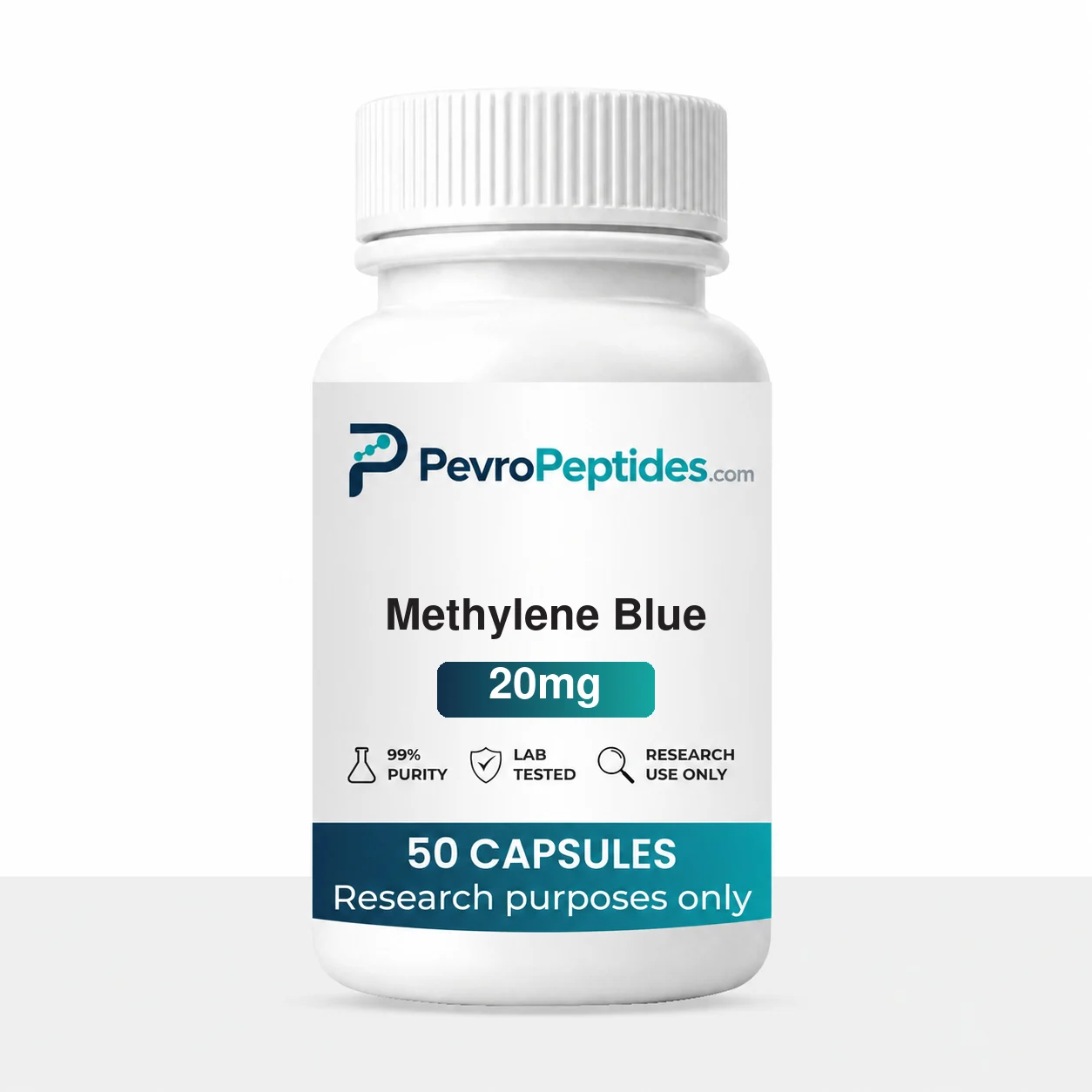
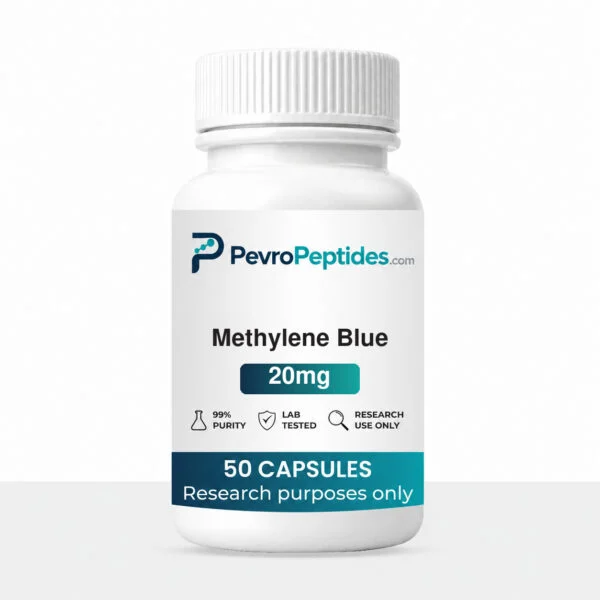
Methylene Blue (methylthioninium chloride) is a synthetic phenothiazinium salt that is studied in controlled laboratory environments in the context of redox chemistry, electron transfer, and molecular regulatory systems. Within scientific research, the compound is used as a model compound and as a reference standard in analytical work. This compound is offered in solid tablet form, with 20 mg per unit.
What is Methylene Blue?
Methylene Blue is built around a tricyclic phenothiazine core: two benzene rings connected to a central ring via a sulfur and a nitrogen atom, each containing a dimethylamino group at positions 3 and 7. The positive charge is delocalized over the thiazinium nitrogen atom and both amino substituents, forming an extended conjugated system; chloride acts as the counterion. This planar, cationic structure determines the analytical behavior: an intense absorption band in the red part of the spectrum and a sharply defined, reversible redox couple.
In research models, Methylene Blue is studied as a reversible electron acceptor: under reducing conditions, the colored cation transforms into the colorless leuco form (leucomethylene blue) via the uptake of two electrons and a proton, a transition that can be monitored spectrophotometrically and electrochemically. The formal potential is approximately +0.011 V relative to the standard hydrogen electrode at pH 7 and is strongly pH-dependent. Additionally, interaction with flavin-dependent disulfide reductases and with soluble guanylate cyclase has been described in enzymatic analyses. Consequently, Methylene Blue is used as a model compound and reference substance within scientific research.
Áreas de investigação
In a laboratory context, Methylene Blue occurs in the following research areas, among others:
- Electrochemical investigation of the methylene blue/leucomethylene blue redox couple and electron transfer at electrode surfaces.
- Application as a redox indicator in titrimetric and enzymological work, where the color change reveals the redox state.
- Studies on electron transfer between donor and acceptor pairs in in vitro cell models.
- Enzyme kinetic research into the interaction of phenothiazinium compounds with flavin-dependent oxidoreductases.
- Analytical method development and validation (UV-Vis spectrophotometry, HPLC, voltammetry) with the compound as the reference standard.
- Staining techniques in microscopic work, in which the cationic chromophore binds to negatively charged structures.
Cada uma destas aplicações envolve investigação controlada em laboratório ou em modelos pré-clínicos.
Especificação analítica
For solid tablet form, the specification is not expressed as a purity percentage, but as content per unit: 20 mg methylthioninium chloride per tablet. Identity and content are determining parameters here, because the compound almost always serves as a quantitative reference: with a high extinction coefficient and an absorption maximum around 664 nm, a small deviation in content translates directly into the measured absorption. An overview of the available analysis documentation can be found on our página de resultados laboratoriais.
Especificações
| Especificação |
Valor |
| Amostra |
Methylene Blue (methylthioninium chloride) |
| Systematic name |
[7-(dimethylamino)phenothiazin-3-ylidene]-dimethylazanium chloride |
| Sinônimos |
Methylthionine chloride; CI Basic Blue 9 |
| Número CAS |
61-73-4 |
| Fórmula molecular / peso |
C16H18ClN3S / ± 319.85 Da |
| PubChem CID |
6099 |
| Aula |
Synthetic phenothiazinium dye salt |
| Forma |
Fixed tablet |
| Content per unit |
20 mg per tablet |
| Armazenar |
Store in a dry and dark place, protected from light and moisture. |
Formato, manuseamento e armazenamento
Methylene Blue is supplied as a solid tablet containing 20 mg per unit, in a sealed research package. In solid form, the material is dark green to blue-black with a metallic luster; in an aqueous environment, the characteristic deep blue color develops. This color change is inherent to the chromophore system and does not constitute an indication of quality or defect. Reconstitution, as is the case with freeze-dried vials, is not applicable here.
Store the material in a dry and dark place in the original packaging; the compound is photoactive, and prolonged exposure to light may affect its analytical usability. Handle the substance with standard laboratory precautions, use appropriate protective equipment, and take into account that the material stains textiles and work surfaces heavily. Dispose of residual material in accordance with applicable laboratory guidelines.
Methylene Blue in our research range
Methylene Blue falls under the category of investigational compounds offered in solid form within our range. While the majority of this category has a receptor-linked target, this substance distinguishes itself through a chemical-physical profile: a defined redox couple and a strong chromophore. Consequently, researchers often use the compound differently from the other components of the line: not as a subject of study within a receptor model, but as a reference within the analytical method itself.
Perguntas frequentes
To which class of substances does Methylene Blue belong?
It is the chloride salt of a synthetic phenothiazinium cation and thus belongs to the heterocyclic aromatic dyes.
Why is the redox couple relevant in research?
The transition between the colored cationic form and the colorless leuco form is reversible and occurs at a well-defined potential. As a result, the redox state can be monitored both visually and instrumentally, making the substance useful as an indicator and analytical reference.
Em que forma é fornecido o composto?
As a solid tablet containing 20 mg methylthioninium chloride per unit, in a sealed research package.
Why is the material so intensely colored?
The highly conjugated phenothiazinium structure absorbs light around 664 nm; the unabsorbed part of the spectrum is perceived as the blue color.
Como devo armazenar o material?
Dry and dark in the original packaging, protected from light and moisture.

















 Levante na loja Woodmart
 Entrega por estafeta
 Entrega por correio DHL



Avaliações
Ainda não existem avaliações.