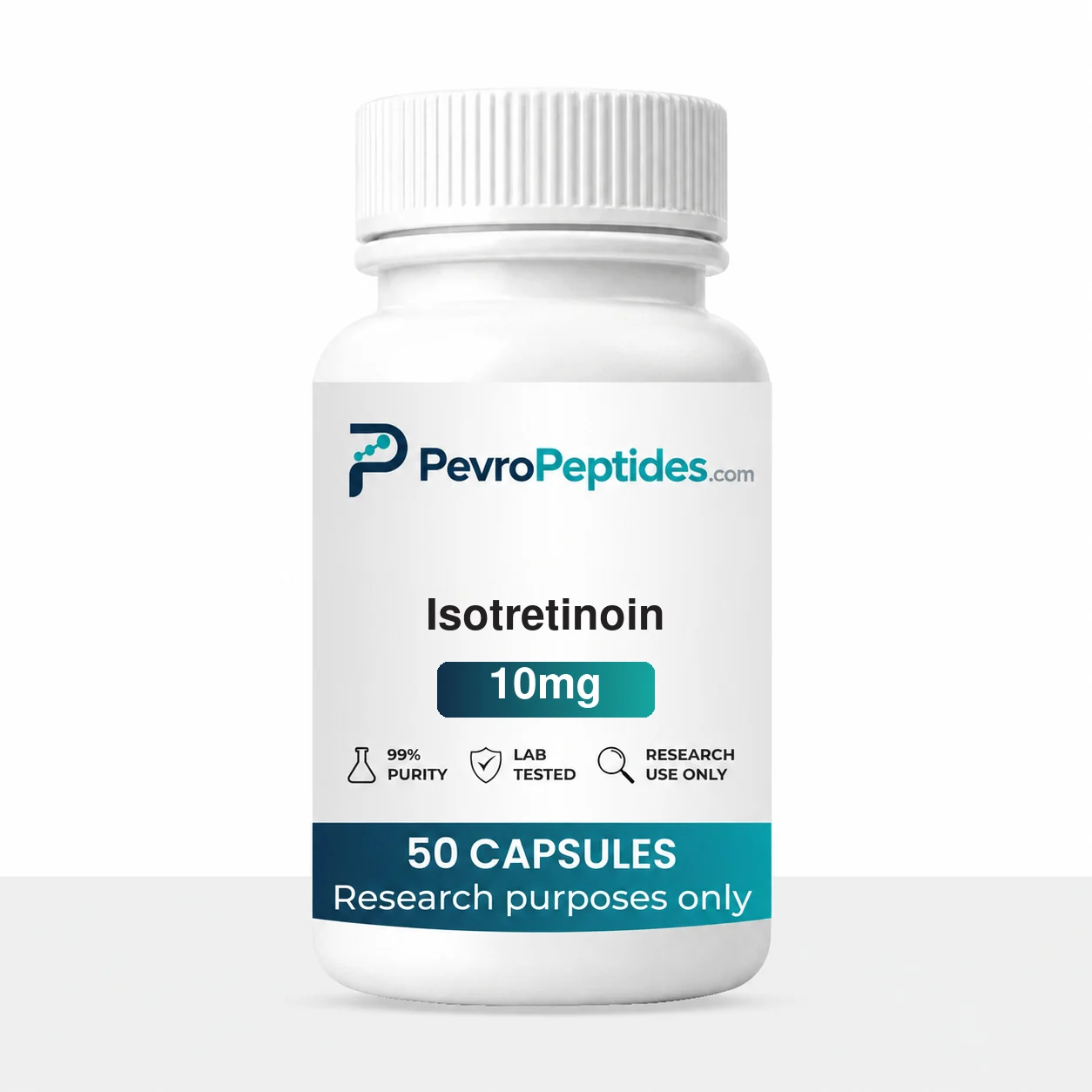
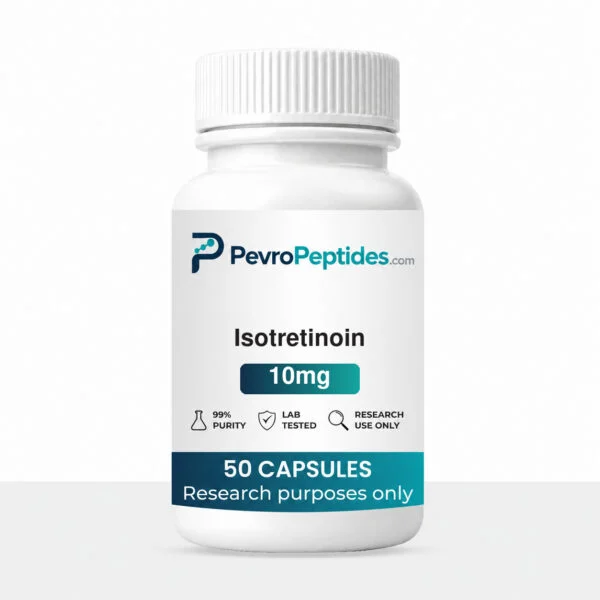
Isotretinoin is a synthetic retinoid, chemically a polyenecarboxylic acid and the 13-cis isomer of all-trans-retinoic acid. In scientific research, it is studied as a model compound for nuclear receptor biology and cis/trans isomerism, and as a reference standard in analytical work. This compound is offered as tablets containing 10 mg of active substance per tablet, exclusively for laboratory and research purposes.
What is Isotretinoin?
Isotretinoin, systematic (2Z,4E,6E,8E)-3,7-dimethyl-9-(2,6,6-trimethylcyclohex-1-ene-1-yl)nona-2,4,6,8-tetraenoic acid, is a small organic molecule of the class of retinoids. The structure consists of a substituted cyclohexene ring (the so-called β-ionone ring), a conjugated chain of four double bonds, and a terminal carboxylic acid group. The distinguishing feature is the cis-configuration at position 13: whereas natural all-trans-retinoic acid has a straight chain, the 13-cis geometry gives the molecule a kink and thus a deviating spatial arrangement. It is precisely this geometric similarity between two otherwise identical molecules that makes the compound a useful model for investigating how only the double-bond geometry determines binding to a protein. Additionally, the conjugated system exhibits strong absorption in the near-UV region, making the substance suitable as a calibration medium with UV detection.
In research models, retinoids act on the nuclear receptors RAR and RXR: ligand-activated transcription factors that bind as heterodimers to response elements in DNA and thus drive gene expression in cell models. Isotretinoin itself binds weakly to these receptors and behaves partly as a precursor compound in cell culture: intracellular isomerization yields the all-trans form, while oxidation by cytochrome P450 enzymes gives 4-oxo metabolites. This combination of non-enzymatic isomerization and enzymatic conversion makes the compound attractive for mechanistic and enzymological laboratory research. Consequently, Isotretinoin is used as a model compound and reference substance within scientific research.
Áreas de investigação
In a laboratory context, Isotretinoin occurs in the following research areas, among others:
- In vitro binding studies of the RAR and RXR subtypes.
- Research into cis/trans isomerization between the 13-cis and all-trans forms under controlled conditions.
- Enzymological research into oxidative conversion by cytochrome P450 enzymes and the formation of 4-oxo metabolites.
- Transcriptional reporter research in cell culture systems in which retinoid response elements constitute the measurable readout.
- Analytical method development and validation (HPLC with UV detection, LC-MS) with Isotretinoin as the reference standard.
- Stability and photodegradation research on conjugated polyene structures.
Cada uma destas aplicações envolve investigação controlada em laboratório ou em modelos pré-clínicos.
Isotretinoin in our research assortment
Isotretinoin falls under the category of oral investigational compounds in solid tablet form within our range. While Isotretinoin focuses on ligand-activated nuclear receptors and isomer geometry, other components within the same product line have been specifically chosen to cover enzymatic or membrane-bound targets. They share the solid tablet form but differ fundamentally in molecular class and investigated mechanism.
Especificações
| Especificação |
Valor |
| Amostra |
Isotretinoin |
| Sinônimos |
13-cis-retinoic acid; (2Z,4E,6E,8E)-3,7-dimethyl-9-(2,6,6-trimethylcyclohex-1-en-1-yl)nona-2,4,6,8-tetraenoic acid |
| Número CAS |
4759-48-2 |
| Fórmula molecular / peso |
C20H28O2 / 300.44 Da |
| PubChem CID |
5282379 |
| Classe |
Small molecule, retinoid (polyenecarboxylic acid) |
| Forma |
Comprimidos |
| Quantidade por comprimido |
10 mg |
| Número de comprimidos por embalagem |
100 |
| Armazenar |
Conservar em local seco, à temperatura ambiente, protegido da luz e da humidade. |
Formato, manuseamento e armazenamento
Isotretinoin is supplied as solid tablets containing a standardized amount of 10 mg of active substance per tablet, packaged in units of 100. This solid form is ready for immediate handling: the tablets can be weighed in a laboratory setup and further analytically processed according to the laboratory's own procedures.
Store the tablets dry at room temperature, protected from direct light and moisture, in the original packaging; the conjugated polyene system is sensitive to light and oxygen. Handle the compound with the usual laboratory precautions: work in a clean environment, use suitable personal protective equipment, and prevent cross-contamination with other research materials. Keep the packaging out of reach of unauthorized persons.
Composição e resultados laboratoriais
For this compound, the content is expressed as the amount of active substance per tablet (10 mg per tablet) rather than as a purity percentage, as is customary for tablet and capsule formulations.
Pode encontrar uma visão geral da documentação analítica disponível no nosso website. página de resultados laboratoriaisOs relatórios são compilados centralmente nesse local, para que possa incorporar os dados nos seus próprios registos de pesquisa.
Perguntas frequentes
To which class of substances does Isotretinoin belong?
Isotretinoin is a small synthetic molecule from the class of retinoids: a conjugated polyene carboxylic acid derived from the vitamin A structure. It is not a peptide and therefore contains no amino acid sequence.
What is the difference compared to all-trans-retinoic acid?
Both molecules have the same molecular formula; the difference lies solely in the geometry of the double bond at position 13. In research models, the 13-cis form partially isomerizes to the all-trans form, making the compound a suitable model for isomeric conversion research.
Em que forma é fornecido o composto?
As tablets with 10 mg of active substance per tablet, packed per 100 tablets in a sealed package.
Como devo conservar os comprimidos?
Dry, at room temperature and protected from light and moisture, preferably in the original packaging. Avoid prolonged exposure to daylight.

















 Levante na loja Woodmart
 Entrega por estafeta
 Entrega por correio DHL



Avaliações
Ainda não existem avaliações.