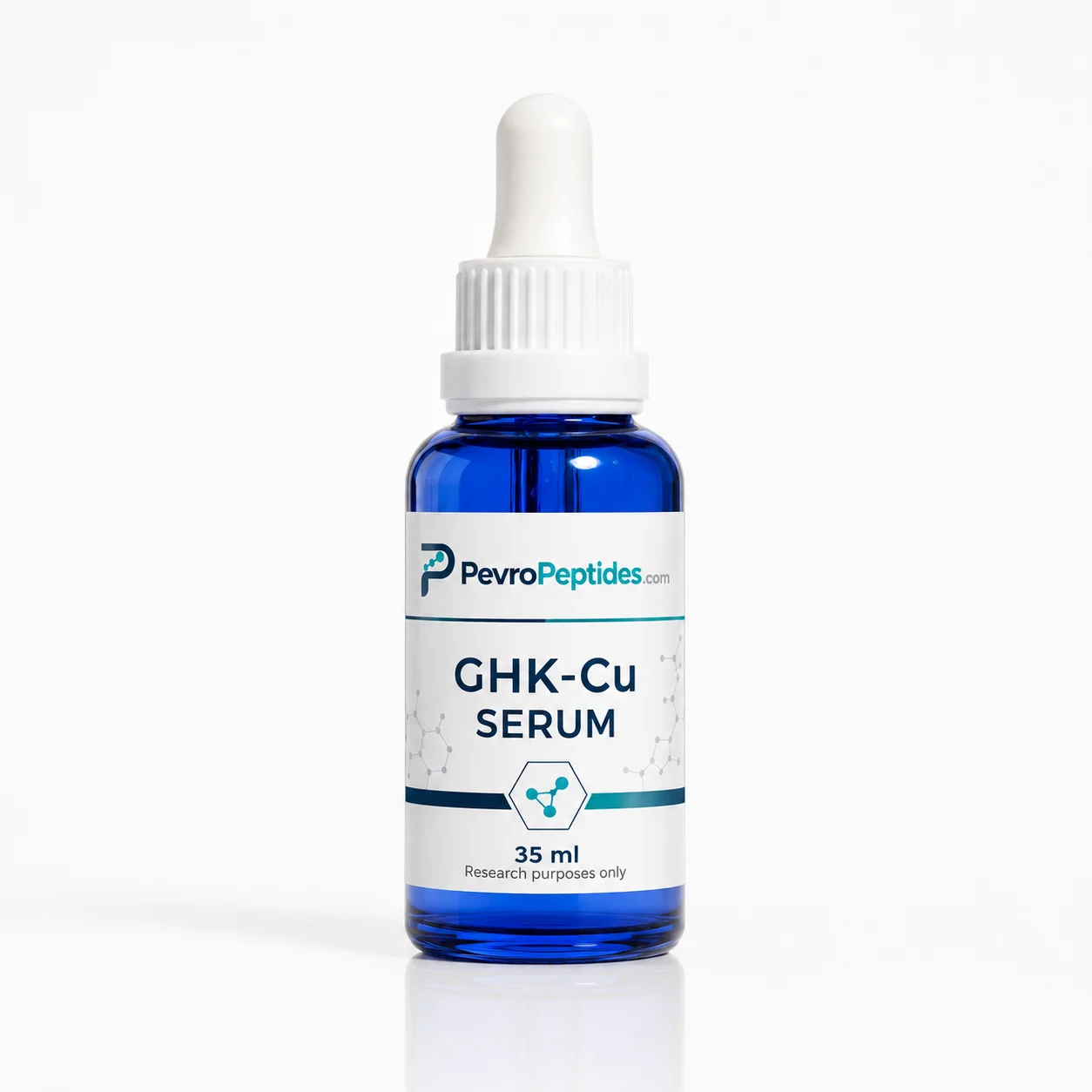
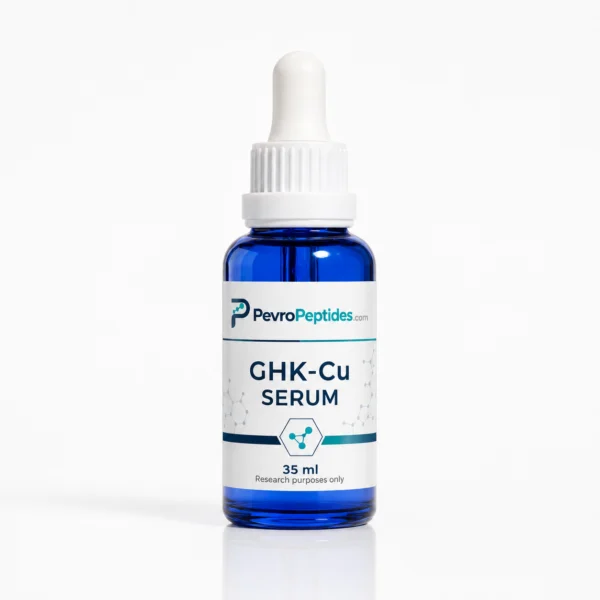
GHK-Cu Serum 35 ml is an aqueous research formulation based on a copper-binding tripeptide, chemically a metallopeptide of glycyl-L-histidyl-L-lysine with a coordinated copper(II) ion. In scientific research, this compound is studied as a model compound for the coordination chemistry of peptide-metal complexes and as a reference standard in analytical work. The product is offered as a ready-to-use aqueous formulation of 35 ml, exclusively for laboratory and research purposes.
Czym jest GHK-Cu?
GHK-Cu is the copper(II) complex of the naturally occurring tripeptide GHK, with the amino acid sequence glycine-histidine-lysine (Gly-His-Lys). The metal ion is fixed in a defined coordination pocket: the bonding mode is typically described as a planar arrangement of three nitrogen donors, namely the α-amino group of the N-terminal glycine, the deprotonated amide nitrogen atom of the first peptide bond, and the imidazole of the histidine. The basic lysine side chain remains outside this arrangement and keeps the complex highly water-soluble. Because this geometry is sharply defined, GHK-Cu is considered a classic model system for copper binding to short peptides in bioinorganic chemistry.
In research models, the complex is primarily studied as an exchangeable copper reservoir: in vitro, under defined conditions, the coordinated ion can be transferred to competing ligands or to copper-dependent enzymes such as lysyl oxidase and superoxide dismutase. Additionally, the copper(II) center makes the formulation easy to monitor spectroscopically: alongside the UV absorption of the imidazole, a weak dd transition occurs in the visible region, which explains the blue color and makes the integrity of the complex measurable. In cell-free systems and fibroblast cultures, the redox balance around the coordinated ion is further investigated. Consequently, GHK-Cu is used as a model compound and reference substance within scientific research.
Obszary badań
W kontekście laboratoryjnym GHK-Cu występuje między innymi w następujących obszarach badawczych:
- Chemia koordynacyjna bionieorganiczna: stałe stabilności, stechiometria i geometria kompleksów miedzi(II)-peptyd.
- Badania enzymatyczne nad enzymami zależnymi od miedzi, w tym oksydazą lizylową i dysmutazą ponadtlenkową, w układach bezkomórkowych.
- Modele hodowli komórkowych umożliwiające konwersję składników macierzy zewnątrzkomórkowej do kultur fibroblastów.
- Formulation research into metallopeptides in an aqueous matrix, including pH-dependent complex stability.
- Opracowywanie i walidacja metod analitycznych (HPLC, UV-vis, LC-MS) z formulacją jako materiałem odniesienia.
- Stability and permeation studies on membrane models under controlled light and temperature conditions.
Każde z tych zastosowań obejmuje kontrolowane badania laboratoryjne lub badania na modelu przedklinicznym.
GHK-Cu Serum in our research assortment
Within our range, this product falls under the category of ready-to-use aqueous investigational formulations in vial form. While this formulation focuses on metal coordination and the associated bioinorganic chemistry, other components within the same product line have been specifically chosen to cover peptide-receptor interactions or enzymatically mediated targets. These products share the aqueous serum base and vial packaging, but differ fundamentally in molecular class and investigated mechanism.
Specyfikacje
| Specyfikacja |
Wartość |
| Próbka |
GHK-Cu (kompleks glicylo-L-histydylo-L-lizyny i miedzi(II)) |
| Synonimy |
tripeptyd miedzi-1; Cu-GHK |
| Sekwencja |
Gly-His-Lys |
| Numer CAS |
89030-95-5 (kompleks miedzi(II)) 49557-75-7 (peptyd GHK) |
| Wzór cząsteczkowy / masa (peptyd GHK) |
C14H24N6O4 / 340,38 Da |
| Identyfikator CID PubChem |
378611 (Cu-GHK) 342538 (GHK) |
| Klasa |
Metalopeptyd; kompleks miedzi(II) z tripeptydem |
| Formularz |
Serum wodne z konserwantem |
| Zawartość na butelkę |
35 ml |
| Składowanie |
Przechowywać w chłodnym miejscu, chronić przed bezpośrednim światłem. |
Kształt, obsługa i przechowywanie
The product is supplied as a ready-to-use aqueous formulation of 35 ml in a vial. No solid needs to be weighed: the active substance is already stabilized in the matrix, together with a preservative that inhibits microbial growth. The liquid has the blue tint characteristic of copper(II) peptides, which comes from the coordinated metal ion. In a research setting, the formulation is applied to model substrates, tissue models, or cell culture preparations in accordance with the applicable laboratory protocol.
Store the vial in a cool, protected place away from direct light, and keep it tightly closed when not in use. Copper(II) complexes are sensitive to light and oxidative conditions, more so in aqueous matrix than in dry form. Handle the product with standard laboratory precautions: work in a clean environment, use appropriate personal protective equipment, and prevent cross-contamination. Keep the packaging out of reach of unauthorized persons.
Skład i wyniki badań laboratoryjnych
The GHK-Cu active ingredient in this formulation is offered with a controlled purity of ≥ 99% (HPLC). That figure refers to the processed metallopeptide and not to the preparation as a whole; the exact active ingredient concentration is available upon request.
Przegląd dostępnej dokumentacji analitycznej znajdziesz na naszej stronie strona z wynikami badań laboratoryjnych, gdzie raporty są gromadzone centralnie.
Często zadawane pytania
Do jakiej klasy substancji należy GHK-Cu?
A metallopeptide: the tripeptide Gly-His-Lys with one coordinated copper(II) ion. Therefore, neither a pure peptide nor an inorganic copper salt.
Jaką rolę odgrywa jon miedzi w badanym mechanizmie?
Jest on utrzymywany przez N-końcową grupę aminową, amidowy atom azotu pierwszego wiązania peptydowego oraz imidazol histydyny. Taka geometria determinuje siłę wiązania i zapewnia pasmo absorpcji dd do kontroli spektroskopowej.
W jakiej formie dostarczany jest ten produkt?
Jako gotowy do użycia preparat wodny o pojemności 35 ml z konserwantem, w butelce.
Jak przechowywać butelkę?
Cool and protected from direct light, tightly closed when not in use.

















 Odbiór w sklepie Woodmart
 Dostawa kurierska
 Dostawa kurierska DHL



Opinie
Na razie nie ma opinii o produkcie.