MGF (Mechano Growth Factor) is a splice variant of insulin-like growth factor 1 (IGF-1), specifically the C-terminal E-domain peptide that arises from alternative splicing of the IGF-1 gene. It is a synthetic peptide of 24 amino acids, also referred to in the literature as IGF-1Ec. Within scientific research, it is studied as a model compound regarding the IGF-1 axis, mechanotransduction, and cellular repair pathways. Intended exclusively for laboratory and research purposes.
What is MGF?
MGF stands for Mechano Growth Factor and is also referred to in the scientific literature as IGF-1Ec — the “Ec” splice variant of insulin-like growth factor 1 (a growth factor protein from the insulin family). When the IGF-1 gene is alternatively spliced under mechanical or hypoxic (oxygen-poor) conditions, a precursor protein is formed whose C-terminal E-domain is released after enzymatic cleavage as the 24-amino acid MGF E-peptide; the remaining part forms mature IGF-1. This structural similarity places MGF within the broader IGF-1 signaling family, but with its own, short-lived E-domain profile that distinguishes it from the complete IGF-1 molecule.
As a research-grade compound, MGF is offered as a freeze-dried powder (lyophilisate) with a defined amino acid sequence. In controlled systems, it serves as a structurally accurate tool to model the dynamics of the IGF-1 axis, satellite cell biology, and mechanically directed signaling. Within scientific research, it is studied exclusively as a model compound, without any application in humans or animals.
Domaines de recherche
In a laboratory context, MGF is used in the following research lines, among others:
- Research into the IGF-1 axis and the role of E-domain splice variants in cellular signaling pathways in vitro.
- Modeling of satellite cell activation and myoblast proliferation in cell culture systems.
- Studies into mechanotransduction — the process by which cells translate mechanical load into biochemical signals.
- Tissue repair and regeneration models after controlled mechanical or hypoxic stress.
- Research into the conformational stability and proteolytic degradation of short E-domain peptides.
- Use as a reference and comparison standard alongside other components of the growth hormone-IGF-1 axis.
These applications concern exclusively preclinical, in vitro, or analytical research models and do not describe effects in humans or animals.
MGF compared with related compounds
MGF is often studied in research alongside other molecules from the growth hormone-IGF-1 axis. The PEG MGFThe -variant is a PEGylated form of the same E-domain peptide, in which the polyethylene glycol group in the study serves to compare the conformational stability and degradation rate with the unmodified peptide. IGF-1 LR3 is a structurally modified IGF-1 analog that is used as the longer reference standard for the IGF-1 axis. Further upstream on the same signal path lie the secretagogues and GHRH analogs: Tesamoréline (a synthetic GHRH(1-44) analog) and Ipamorelin (a selective agonist of the ghrelin receptor) are being studied as upstream modulators of growth hormone signaling. Together, these compounds form a spectrum that allows researchers to model different levels of the same axis.
Caractéristiques
| Spécification |
Valeur |
| Échantillon |
MGF (Mechano Growth Factor) |
| Synonymes |
IGF-1Ec, MGF E-peptide (IGF-1 splice variant) |
| Séquence |
YQPPSTNKNTKSQRRKGSTFEERK (24 amino acids) |
| Formule moléculaire / masse moléculaire |
C₁₂₁H₁₉₉N₄₁O₄₀ / 2868.1 Da |
| PubChem CID |
175675731 |
| Classe |
IGF-1 splice variant (E domain peptide) |
| Formulaire |
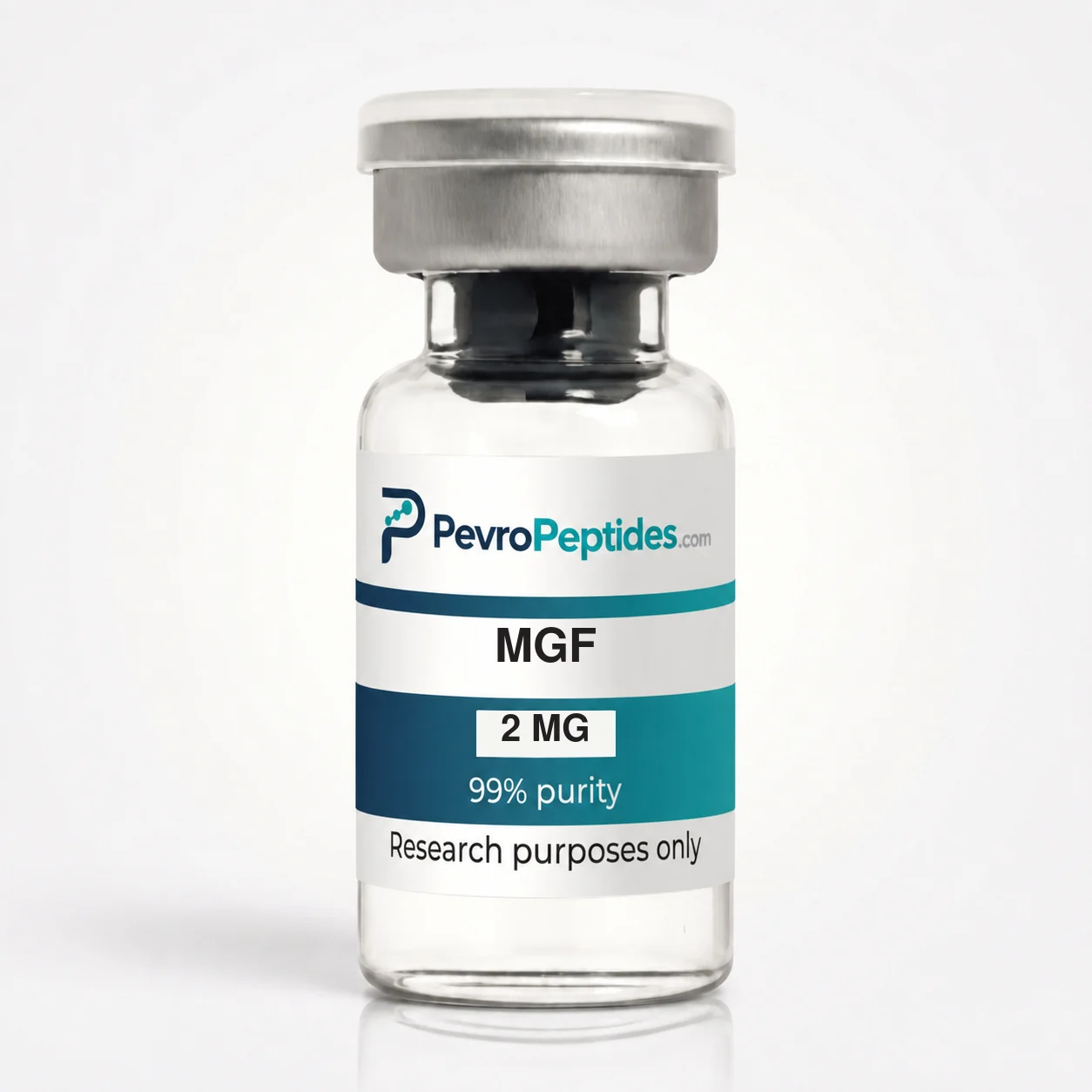
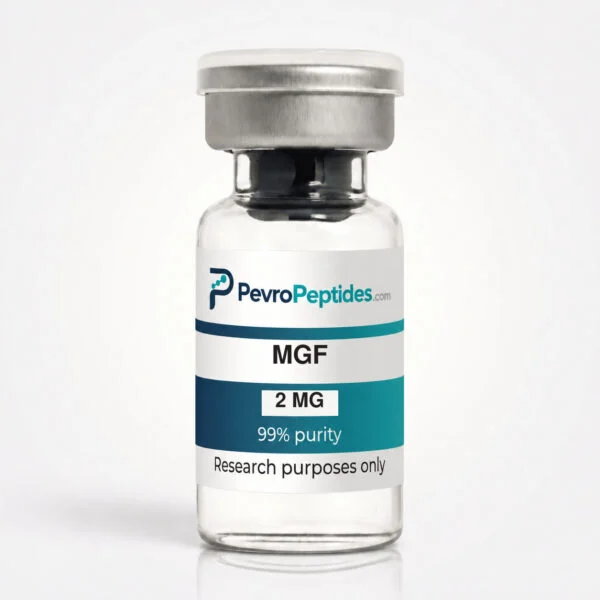
Lyophilized powder (dry powder) — 2 mg per vial |
| Pureté |
≥ 99 % (HPLC) |
| Stockage |
Store refrigerated or at −20 °C, protected from light and moisture. |
Forme, manipulation et stockage
MGF is supplied as freeze-dried powder (lyophilized powder) in a 2 mg vial. The lyophilized powder is most stable in its dry form and should be stored refrigerated and protected from light and moisture; for long-term storage, a temperature of −20 °C is maintained. Reconstitution in a laboratory context is typically performed using bacteriostatic water. After reconstitution, the solution is stored refrigerated (2–8 °C) and protected from repeated temperature fluctuations, as short peptides are susceptible to proteolytic degradation. Handle the sample with standard laboratory hygiene and limit unnecessary freeze-thaw cycles to preserve sequence integrity.
Pureté et résultats de laboratoire
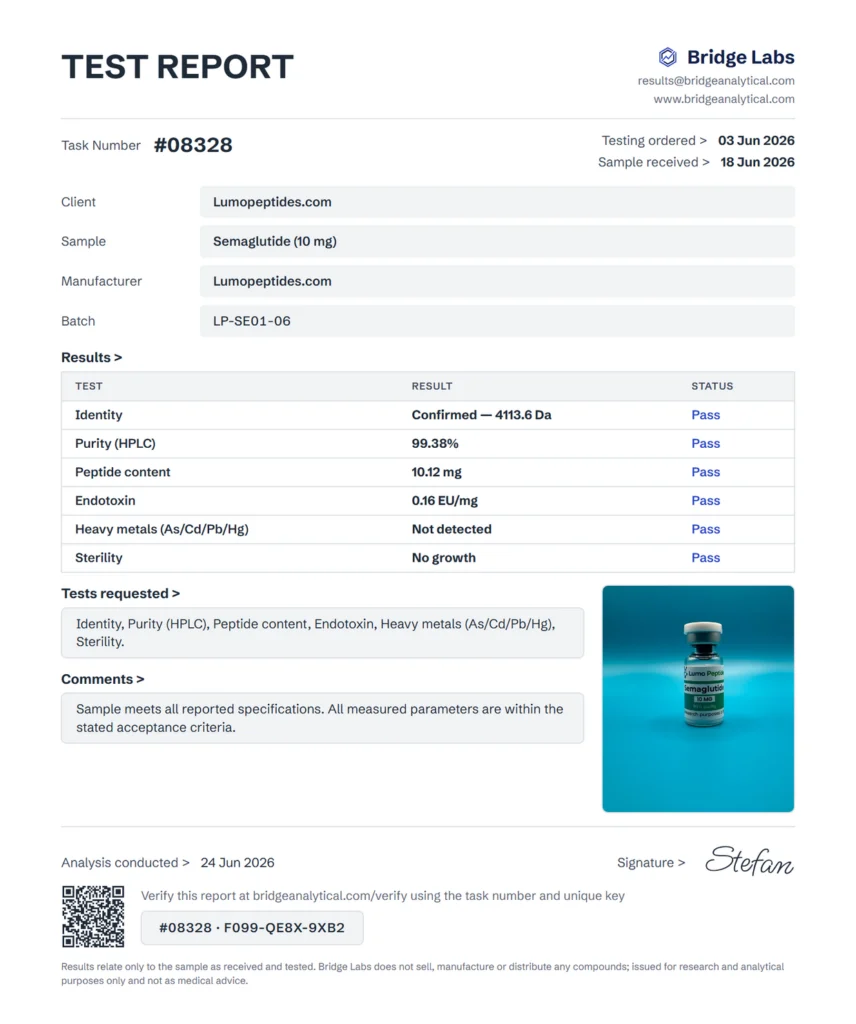
MGF is offered with a controlled purity of ≥ 99%, determined by high-performance liquid chromatography (HPLC) — a standard technique for establishing the identity and homogeneity of synthetic peptides. Certificates of analysis and additional lab results can be found on our website. page de résultats de laboratoire.
Foire aux questions
What is the difference between MGF and IGF-1?
MGF is the C-terminal E-domain peptide formed by alternative splicing of the IGF-1 gene; mature IGF-1 is the remaining part left after enzymatic cleavage. Both share the same genetic origin, but MGF has its own, shorter structural profile.
What is the difference between MGF and PEG MGF?
PEG MGF is the same E-domain sequence featuring a polyethylene glycol group. In research, PEGylation is used to compare the conformational stability and degradation rate with the unmodified peptide.
In what form is MGF supplied?
As freeze-dried powder (lyophilized powder) in a 2 mg vial, with a purity of ≥ 99% (HPLC).
How is MGF stored?
Dry, refrigerated, and protected from light and moisture; for long-term storage at −20 °C. After reconstitution, store refrigerated (2–8 °C) and avoid freeze-thaw cycles as much as possible.
Is MGF suitable for use in humans or animals?
No. MGF is offered exclusively for laboratory and research purposes and is not a medicine, dietary supplement, or cosmetic product.
Vous voulez en savoir plus ? Consultez notre guide : Explication des peptides HGH : analogues de la GHRH, GHRP et différence avec la véritable hormone de croissance.
Destiné exclusivement à des fins de laboratoire et de recherche. Ne pas consommer, ni utiliser à des fins médicales, diagnostiques, thérapeutiques ou cosmétiques. L'acheteur est âgé de 18 ans ou plus et confirme le contexte de recherche. Ceci n'est pas un médicament.

















 À récupérer au magasin Woodmart
 Livraison par coursier
 Livraison par DHL



Avis
Il n’y a pas encore d’avis.