For laboratory and research purposes only. Not for human or veterinary use.
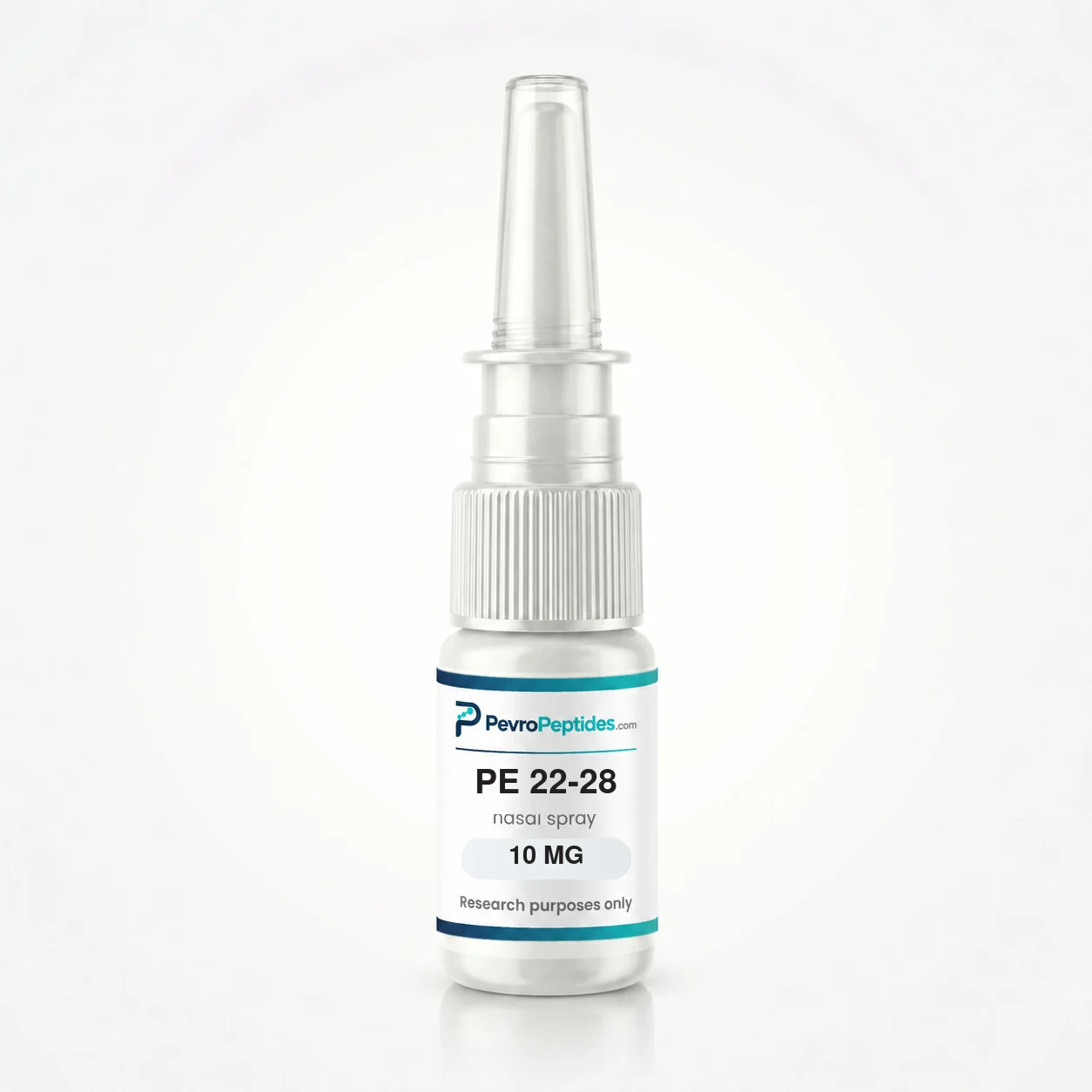
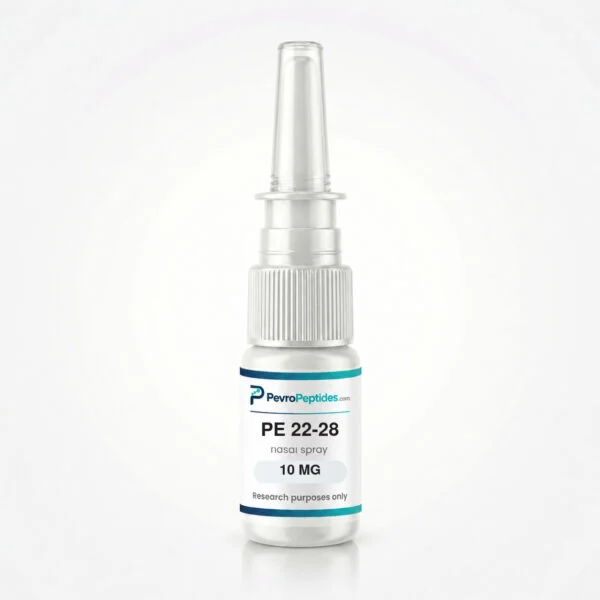
PE 22-28 is a synthetic heptapeptide that is studied in controlled laboratory settings within the context of peptide-mediated signaling pathways and molecular regulatory systems. In scientific research, the compound is used as a model compound and as a reference standard in analytical work. This set contains the compound as freeze-dried lyophilisate in a sealed 10 mg research vial, with a sterile saline solution (0.9% NaCl) and an empty spray bottle.
What is PE 22-28?
PE 22-28 is a linear peptide of seven amino acid residues with the sequence Gly-Val-Ser-Trp-Gly-Leu-Arg. The compound corresponds to residues 22 through 28 of spadin, the longer propeptide fragment from which this sequence is derived. Within this short chain, the molecule combines widely divergent side chains: the aromatic indole ring of tryptophan, the positively charged guanidine group of arginine, and the polar hydroxyl function of serine. This alternation determines the hydrophobicity, conformational flexibility, and binding profile of the peptide.
In research models, PE 22-28 is described in relation to the TREK-1 channel (gene product KCNK2), a potassium channel with two pore domains (K2P). This interaction is studied in in vitro electrophysiological model systems, in which the peptide serves as a defined input to characterize signal transduction in cell models. Due to its compact molecular profile and reproducible analytical behavior, the compound regularly serves as a reference in comparative peptide studies. Consequently, PE 22-28 is used as a model compound and reference substance within scientific research.
Research areas
In a laboratory context, PE 22-28 occurs in the following research areas, among others:
- Research into the interaction between short peptide sequences and channel proteins from the K2P family in vitro.
- Studies on peptide-mediated signaling pathways and molecular regulatory networks in controlled cell models.
- Structure-activity relationship study into the contribution of individual residues to binding affinity.
- Comparative fragment analysis between the full propeptide sequence and the shortened analog.
- Conformation and stability studies of short linear peptides after lyophilization.
- Analytical method development and validation (HPLC, LC-MS, UV spectrometry) using PE 22-28 as the reference standard.
Each of these applications involves controlled laboratory or preclinical model research.
Analytical specification
The material is submitted with a controlled purity of ≥ 99%, determined via high-pressure liquid chromatography (HPLC). Identity and purity are determining parameters in analytical peptide work: in a seven-residue sequence, truncation or deletion variants closely resemble the target compound yet exhibit aberrant binding behavior, which affects comparability between experiments. An overview of the available analysis documentation can be found on our lab results page.
Specifications
| Specification |
Value |
| Sample |
PE 22-28 |
| Synonyms |
PE-22-28; spadin fragment 22-28 |
| Sequence |
Gly-Val-Ser-Trp-Gly-Leu-Arg (GVSWGLR) |
| CAS number |
1801959-12-5 |
| Molecular formula / weight |
C35H55N11O9 / ± 773.9 Da |
| PubChem CID |
165437303 |
| Class |
Synthetic linear heptapeptide |
| Form |
Freeze-dried lyophilisate in sealed vial |
| Quantity per vial |
10 mg |
| Purity |
≥ 99% (HPLC) |
| Storage |
Store in a cool, dark place, protected from light and moisture. |
Shape, handling and storage
PE 22-28 is supplied as freeze-dried lyophilisate in a sealed 10 mg vial. The lyophilization process preserves the molecular integrity of the peptide during storage and transport. The material presents as a white to off-white powder or as a compact cake at the bottom of the vial; both appearances are normal. The set also includes a sterile physiological saline solution and an empty spray bottle.
Store the sealed lyophilisate in a cool, dry, and dark place in the original packaging, protected from light and moisture. Observe the usual laboratory precautions: work in a clean environment, use appropriate personal protective equipment, prevent cross-contamination with other research materials, and keep the packaging out of reach of unauthorized persons. Dispose of residual material in accordance with applicable laboratory guidelines.
PE 22-28 in our research range
PE 22-28 falls under the category of freeze-dried investigational compounds offered as a complete set within our range. While PE 22-28 distinguishes itself through its short linear sequence and channel-linked action, other components within the same product line have been specifically selected to cover receptor-linked, enzymatic, or metal-linked interactions. These compounds share the freeze-dried vial form but differ fundamentally in molecular class and investigated mechanism.
Frequently Asked Questions
To which substance class does PE 22-28 belong?
PE 22-28 is a synthetic linear heptapeptide with the sequence Gly-Val-Ser-Trp-Gly-Leu-Arg, and belongs to the short synthetic peptide fragments.
Why is the short sequence relevant in research?
Seven residues are small enough to be fully characterized and large enough for a defined binding profile. This makes the compound useful in structure-activity relationship research and as a reference in analytical methods.
In what form is the compound supplied?
As freeze-dried lyophilisate in a sealed 10 mg vial with a purity of ≥ 99% (HPLC), together with a sterile saline solution and an empty spray bottle.
Why does the powder sometimes look like a cake?
During freeze-drying, the material can contract into a compact layer. Both a loose powder and a cake are normal forms of lyophilized peptide material.
How do I store the material?
Store in a cool, dry, and dark place in the original packaging, protected from light and moisture.

















 Pick up from the Woodmart Store
 Courier delivery
 DHL Courier delivery



Reviews
There are no reviews yet.