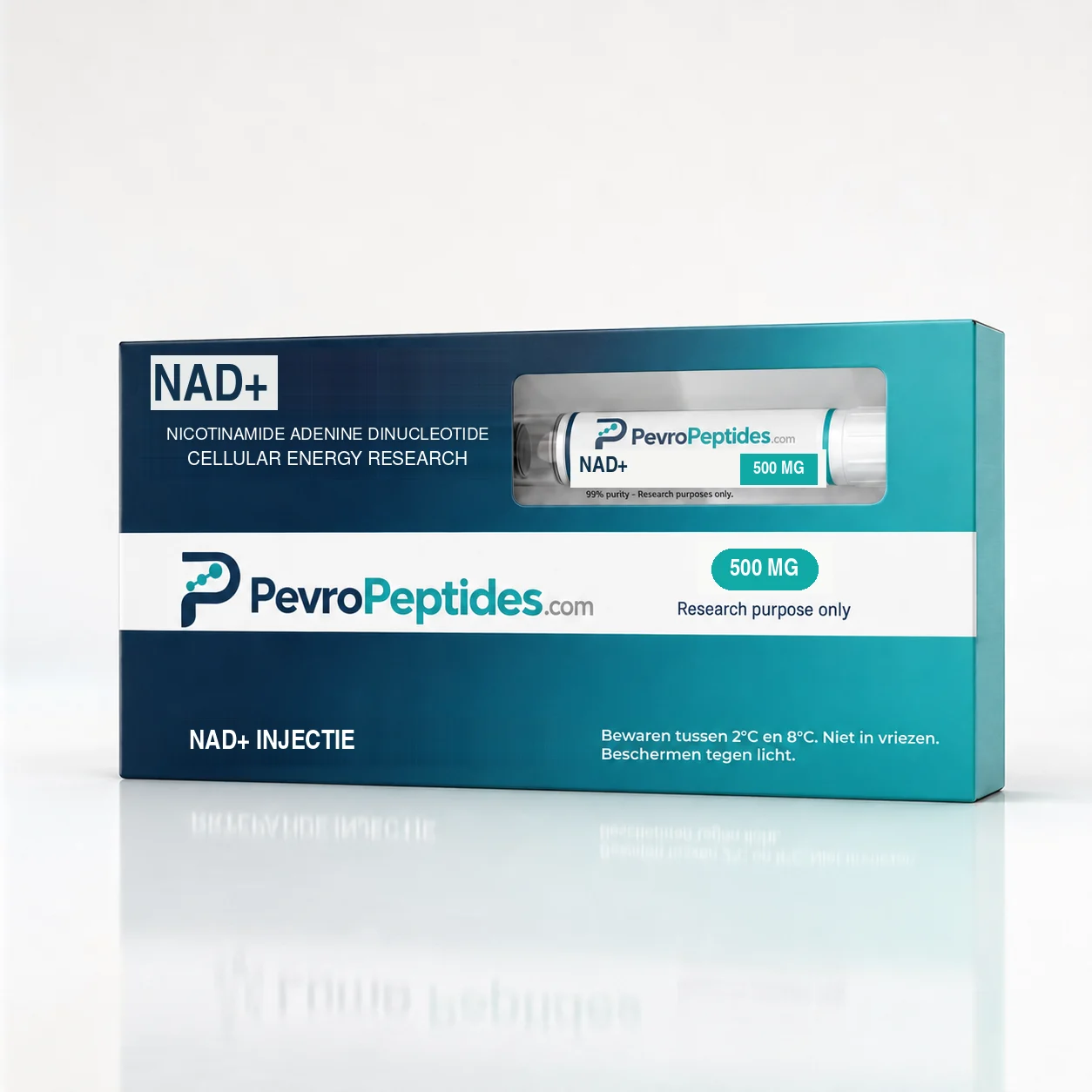
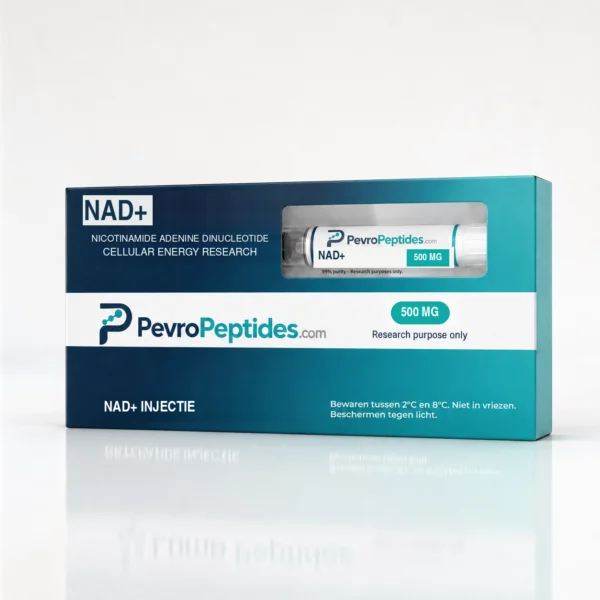
NAD+ (nicotinamide-adenine-dinucleotide) is a naturally occurring coenzyme, chemically a dinucleotide composed of a nicotinamide and an adenine nucleotide. In scientific research, it is studied as a model compound for redox biochemistry and enzyme kinetics and as a reference standard in analytical work. This compound is offered as a 3 ml pre-filled injection pen containing 500 mg, exclusively for laboratory and research purposes.
What is NAD+?
NAD+ (β-nicotinamide-adenine-dinucleotide) is a dinucleotide in which two ribonucleotides are joined via their 5′-phosphate groups to form a pyrophosphate bridge: an adenine ribonucleotide on one side and a nicotinamide ribonucleotide with a positively charged pyridinium ring on the other. This asymmetric structure—a recognizable adenosine region next to a redox-active pyridinium ring—makes the compound a widely used model in the study of cofactor recognition, binding site geometry, and electron transfer.
In research models, NAD+ functions as a reversible hydride acceptor: the nicotinamide ring accepts a hydride ion at position C4, resulting in the reduced form NADH. This NAD+/NADH couple forms the basis of numerous in vitro enzyme assays, because the conversion can be monitored spectrophotometrically by the characteristic absorption of NADH at 340 nm. Additionally, NAD+ is studied in cell models as a co-substrate for NAD+-consuming enzymes such as sirtuins, poly(ADP-ribose) polymerases, and CD38, which cleave the glycosidic bond between nicotinamide and ADP-ribose, thereby releasing nicotinamide. Consequently, NAD+ is used as a model compound and reference substance within scientific research.
Research areas
In a laboratory context, NAD+ occurs in the following research areas, among others:
- Enzyme kinetic study of NAD+-dependent dehydrogenases, in which the NAD+/NADH couple is spectrophotometrically monitored in vitro.
- Research into NAD+-consuming enzymes (sirtuins, poly(ADP-ribose)polymerases, CD38) and their co-substrate dependence in cell-free systems.
- Biochemical model studies of the salvage pathway and the enzymes NAMPT and NMNAT involved in the formation of dinucleotide cofactors.
- Redox biochemistry and structure-activity research on pyridine nucleotides and their structural analogs.
- Analytical method development and validation (HPLC, LC-MS) using NAD+ as the reference standard.
- Stability and solubility studies of freeze-dried nucleotide cofactors under controlled conditions.
Each of these applications involves controlled laboratory or preclinical model research.
NAD+ within our research range
This version belongs to the line of pre-filled injection pens: compounds contained in dissolved form in a sealed cartridge, so that a researcher does not need to go through their own dissolution step. The same compound is available elsewhere in the range as freeze-dried lyophilisate in a vial. Other compounds within the pen line act on a completely different biochemical system; the form indicates nothing about the substance class.
Specifications
| Specification |
Value |
| Sample |
NAD+ (nicotinamide adenine dinucleotide) |
| Synonyms |
β-NAD; β-nicotinamide adenine dinucleotide; diphosphopyridine nucleotide (DPN); coenzyme I |
| CAS number |
53-84-9 |
| Molecular formula / weight |
C21H27N7O14P2 / 663.43 Da |
| PubChem CID |
5892 |
| Class |
Dinucleotide coenzyme, redox cofactor (non-peptide) |
| Form |
Pre-filled injection pen with sealed cartridge |
| Quantity per unit |
500 mg per 3 ml pen |
| Quantity per package |
1 pen, 10 pen needles and alcohol wipes |
| Storage |
Refrigerated at 2–8 °C, store in a dark place. |
Shape, handling and storage
The compound is dissolved in a sealed 3 ml glass cartridge in a pen with a click mechanism. A separate dissolution step is not required with this version; the cartridge remains closed until a needle is inserted. The label includes a table showing the relationship between click settings and dispensed volume, allowing sample collections to be reproducibly recorded in a protocol.
Store the pen refrigerated between 2 and 8 °C, protected from light and in the original packaging. Handle the pen in a clean working environment, use a new sterile needle for each draw to prevent cross-contamination, and wear standard personal protective equipment. Keep the material out of reach of unauthorized persons.
Composition and lab results
The raw material used has a controlled purity of ≥ 99% (HPLC). The pen contains NAD+ in a sterile aqueous base; the total amount of active substance is stated on the label for each version.
Analysis certificates of the relevant parties are on our lab results page.
Frequently Asked Questions
To which substance class does NAD+ belong?
NAD+ is not a peptide, but a dinucleotide coenzyme: two ribonucleotides (adenine and nicotinamide) connected by a pyrophosphate bridge. It therefore contains no amino acid sequence and belongs to the class of pyridine nucleotide cofactors.
What is the difference between NAD+ and NADH in research?
NAD+ is the oxidized form and NADH the reduced form of the same molecule. In vitro, the nicotinamide ring at position C4 accepts a hydride ion, producing NADH. Because only NADH absorbs strongly at 340 nm, this conversion can be directly monitored spectrophotometrically in enzyme analysis.
In what form is the compound supplied?
As a pre-filled injection pen with a sealed 3 ml cartridge containing 500 mg. The box also contains ten sterile pen needles and alcohol wipes.
How do I store the pen?
Refrigerated between 2 and 8 °C, in a dark place and in the original packaging. Do not freeze.















 Pick up from the Woodmart Store
 Courier delivery
 DHL Courier delivery


 Overview

Reviews
There are no reviews yet.