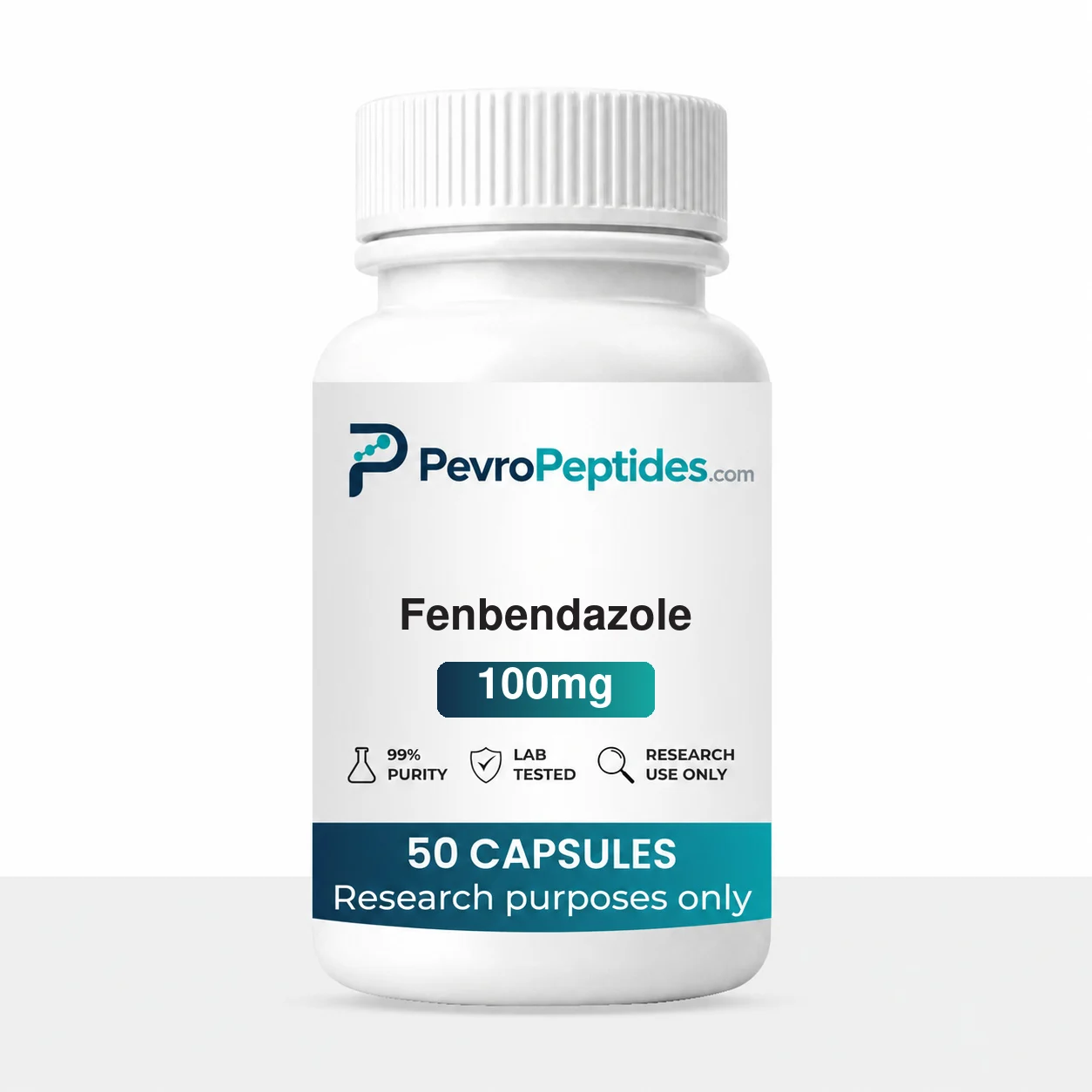
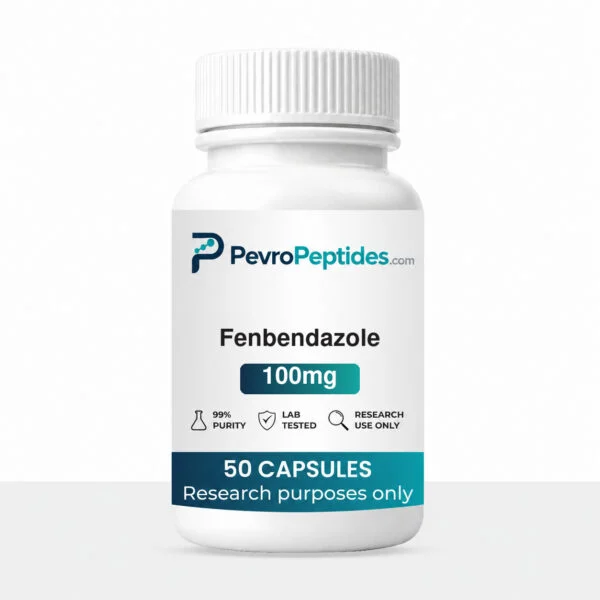
Fenbendazole is a synthetic small molecule belonging to the class of benzimidazole carbamates, chemically a 2-carbamate benzimidazole with a phenylthio substituent. In scientific research, it is studied as a model compound for tubulin interaction and oxidative biotransformation and as a reference standard in analytical work. This compound is offered as tablets containing 100 mg of active substance per tablet, exclusively for laboratory and research purposes.
What is Fenbendazole?
Fenbendazole (methyl-N-(6-phenylsulfanyl-1H-benzimidazol-2-yl)carbamate) is a small organic molecule with the formula C15H13N3O2S and a molecular weight of 299.35 Da. The structure consists of three clearly distinguishable parts: the planar benzimidazole core, a methylcarbamate group at position 2, and a thioether connecting the core to a phenyl ring via a sulfur atom. This structure yields a strongly nonpolar molecule, barely soluble in water, with a high partition coefficient, while the benzimidazole nitrogen atom imparts a weakly acidic character. This combination makes Fenbendazole a widely used model compound in solubility research.
In research models, two mechanistic pathways are central. First, in vitro, the compound binds to beta-tubulin at the same site as colchicine, thereby delaying microtubule formation in cell-free polymerization assays; this makes it a useful tool in cytoskeleton and cell division research. Second, the disulfide bridge is the target of a two-stage oxidation: flavin-containing monooxygenases and cytochrome P450 enzymes first convert the thioether into the sulfoxide metabolite (oxfendazole) and subsequently into the corresponding sulfone. This sequential conversion makes the compound suitable for enzymatic and metabolic laboratory research. Accordingly, Fenbendazole is used as a model compound and reference substance within scientific research.
Research areas
In a laboratory context, Fenbendazole is found in the following research areas, among others:
- Biochemical research into the binding of benzimidazole carbamates to beta-tubulin and into microtubule polymerization in cell-free assays.
- Cell culture models in which cytoskeleton organization and cell cycle progression are monitored in vitro.
- Enzymological investigation into the two-stage oxidation of the thioether to sulfoxide and sulfone by monooxygenases and cytochrome P450 enzymes.
- Structure-activity study in which the substituent on the benzimidazole core is gradually varied.
- Analytical method development and validation (reverse-phase HPLC, LC-MS) in which Fenbendazole serves as the reference standard for the separation of the parent compound and oxidation products.
- Solubility and stability studies of poorly water-soluble, weakly acidic compounds under controlled conditions.
Each of these applications involves controlled laboratory or preclinical model research.
Fenbendazole in our research assortment
Fenbendazole falls under the category of oral investigational compounds in solid tablet form within our product range. While this compound focuses on interaction with a cytoskeletal structural protein and on oxidative conversion, other components within the same product line have been specifically selected to cover receptor-linked or enzymatic targets, or to serve as peptide fragments. They share the solid tablet form but differ fundamentally in molecular class and investigated mechanism.
Specifications
| Specification |
Value |
| Sample |
Fenbendazol |
| Synonyms |
methyl N-(6-phenylsulfanyl-1H-benzimidazol-2-yl)carbamate; fenbendazole; fenbendazolum |
| CAS number |
43210-67-9 |
| Molecular formula / weight |
C15H13N3O2S / 299.35 Da |
| PubChem CID |
3334 |
| Class |
Small molecule, benzimidazole carbamate |
| Form |
Tablets |
| Quantity per unit |
100 mg per tablet |
| Quantity per package |
100 tablets |
| Storage |
Store in a dry place at room temperature, protected from light and moisture. |
Shape, handling and storage
Fenbendazole is supplied as solid tablets with a standardized amount of 100 mg per tablet, packaged in units of 100. This solid form can be weighed directly in a laboratory setup. For analytical work, the very limited water solubility is the determining factor: separation methods typically work with an organic component in the mobile phase, and extraction from the tablet matrix requires an approach determined by the laboratory itself.
Store the tablets dry at room temperature, protected from direct light and moisture, in the original packaging. Handle the compound with the usual laboratory precautions: clean environment, suitable protective equipment, no cross-contamination. Keep the packaging out of reach of unauthorized persons.
Composition and lab results
For this compound, the content is expressed as the amount of active substance per tablet (100 mg per tablet) rather than as a purity percentage, as is customary for tablet and capsule formulations.
An overview of the analytical documentation is on our lab results pageThe reports are collected centrally there.
Frequently Asked Questions
To which class of substances does Fenbendazole belong?
It is a small synthetic molecule from the group of benzimidazole carbamates, with a thioether bridge to a phenyl ring. It is not a peptide and therefore contains no amino acid sequence.
What role do oxidation products play in research?
In research models, the thioether is oxidized by monooxygenases and cytochrome P450 enzymes first to the sulfoxide metabolite and subsequently to the sulfone. These two consecutive steps are a classic subject in enzymological work and analytically require the separation of three closely related compounds.
In what form is the compound supplied?
As tablets with 100 mg of active substance per tablet, packed per 100 pieces.
How do I store the tablets?
Dry, at room temperature and protected from light and moisture, preferably in the original packaging.


















 Pick up from the Woodmart Store
 Courier delivery
 DHL Courier delivery




Reviews
There are no reviews yet.