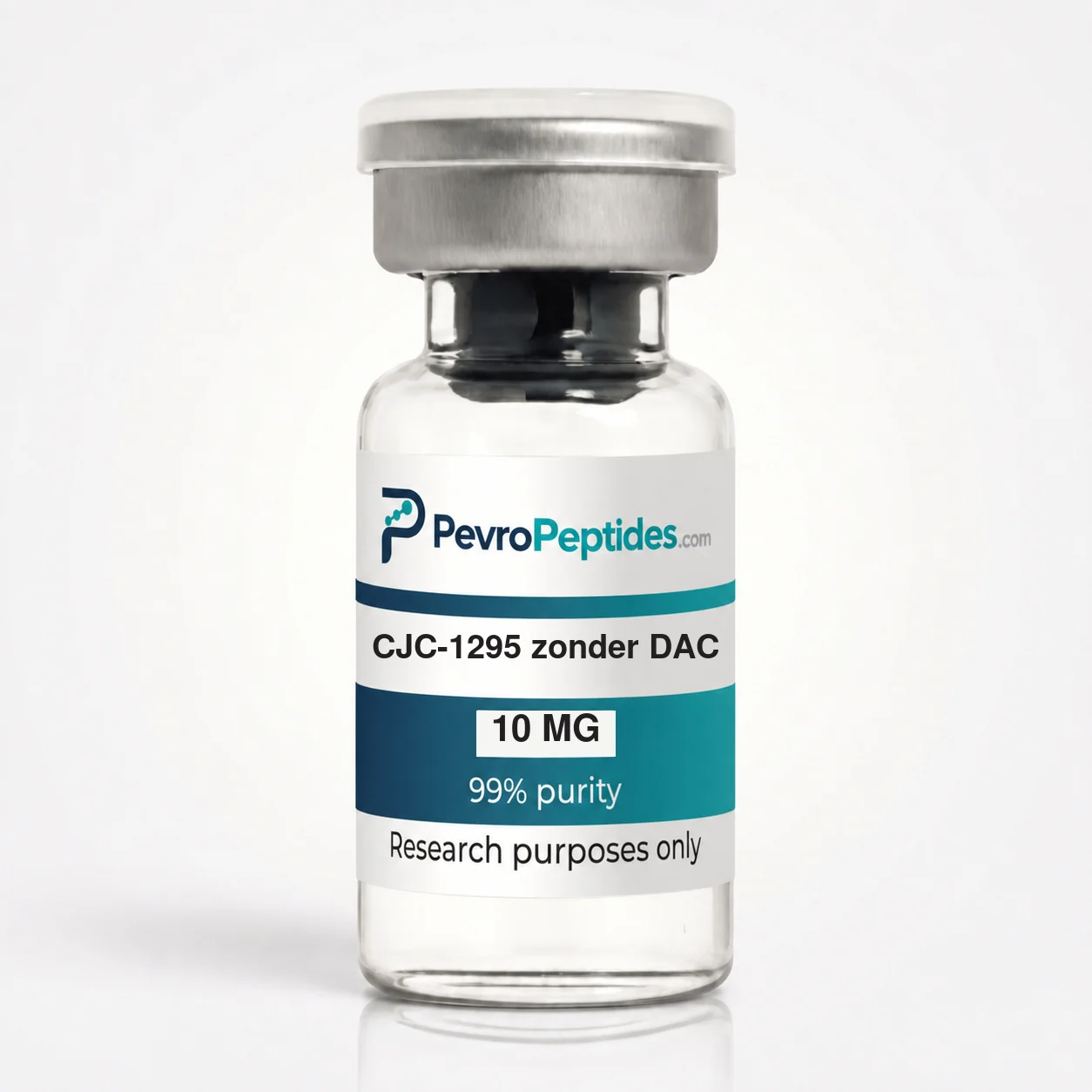
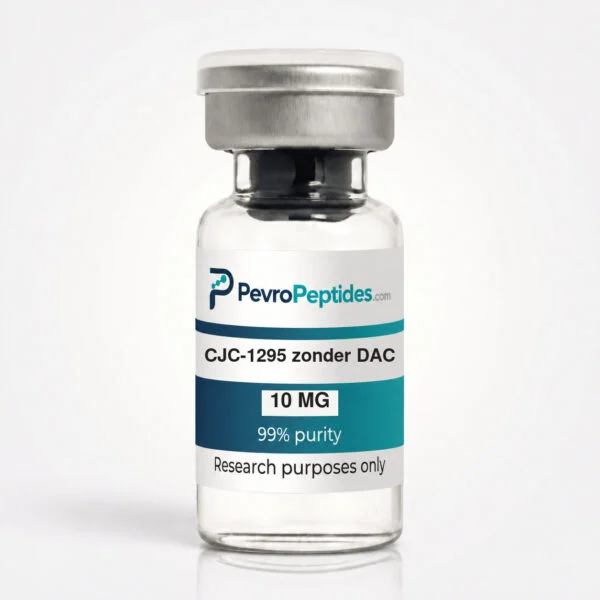
CJC-1295 without DAC is a synthetic peptide from the class of GHRH analogs, chemically a tetrasubstituted 29-amino acid fragment of growth hormone-releasing hormone with a C-terminal amide. Within scientific research, it is studied as a model compound for receptor-mediated signal transduction and as a reference standard in analytical work. This compound is offered as a freeze-dried powder of 10 mg per vial, exclusively for laboratory and research purposes.
What is the CJC-1295 without a DAC?
CJC-1295 without DAC, also referred to in the literature as Mod GRF (1-29), corresponds to the first 29 amino acids of human GHRH, in which four positions have been replaced: D-alanine at 2, glutamine at 8, alanine at 15, and leucine at 27. The chain ends in an amide function instead of a free carboxyl group. It is precisely these substitutions that make the molecule a widely used model in peptide engineering: they demonstrate how limited changes in a natural sequence alter sensitivity to enzymatic degradation without disrupting receptor recognition.
In research models, the compound binds to the GHRH receptor (GHRHR), a class B G-protein-coupled receptor. In cell models, this binding leads via Gs coupling to activation of adenylyl cyclase, an increase in intracellular cAMP, and activation of protein kinase A—a cascade that can be effectively monitored in vitro using cAMP assays. The D-alanine at position 2 protects the N-terminus from cleavage by dipeptidylpeptidase-4; without the Drug Affinity Complex, the molecule does not form a covalent bond with albumin in model systems, causing the kinetic profile in vitro to differ from the DAC variant. Therefore, within scientific research, CJC-1295 without DAC is used as a model compound and reference substance.
Research areas
In a laboratory context, CJC-1295 without DAC occurs in the following research areas, among others:
- Receptor research into the GHRH receptor (GHRHR) and ligand-receptor interaction in in vitro cell models.
- Research into Gs-coupled signal transduction, with the cAMP response in somatotropic cell lines as the readout parameter.
- Enzymological research into the resistance of D-Ala2-peptides against dipeptidylpeptidase-4.
- Structure-activity relationship study in which the substitutions are compared with the unchanged GHRH(1-29) sequence.
- Analytical method development and validation (HPLC, LC-MS) with the peptide as the reference standard.
- Stability and solubility studies of freeze-dried peptides under controlled conditions.
Each of these applications involves controlled laboratory or preclinical model research.
CJC-1295 without DAC in our research range
CJC-1295 without DAC falls under the category of freeze-dried peptides in vial form within our product range. Researchers regularly combine the compound with peptides studied via their own biochemical target. While CJC-1295 without DAC targets a class B G-protein-coupled receptor, other components within the same product line cover receptors from other families or enzymatic pathways. These compounds share the freeze-dried vial form but differ fundamentally in sequence and investigated mechanism.
Specifications
| Specification |
Value |
| Sample |
CJC-1295 without DAC |
| Synonyms |
Modified GRF (1-29); tetrasubstituted GRF (1-29); [D-Ala2, Gln8, Ala15, Leu27]-GHRH(1-29)-amide |
| CAS number |
863288-34-0 |
| Molecular formula / weight |
C152H252N44O42 / 3367,9 Da |
| PubChem CID |
91976842 |
| Class |
Synthetic peptide, GHRH(1-29) analog without Drug Affinity Complex |
| Form |
Freeze-dried powder (lyophilisate) in vial |
| Quantity per vial |
10 mg |
| Number of vials per package |
1 |
| Storage |
Keep refrigerated, protected from light and moisture |
Shape, handling and storage
CJC-1295 without DAC is supplied as a freeze-dried powder (lyophilisate) with a standardized quantity of 10 mg per vial. Unlike a solid tablet form, a lyophilisate is first dissolved in a suitable solvent in the laboratory before analytical work is possible; the dry material is significantly more stable than dissolved.
Store the unopened vial refrigerated, protected from light and moisture, in the original packaging. Handle the compound with standard laboratory precautions: work cleanly, use appropriate protective equipment, and prevent cross-contamination. Keep the packaging out of reach of unauthorized persons.
Composition and lab results
For this lyophilisate, a controlled purity of ≥ 99% (HPLC) is maintained. The content is expressed as 10 mg peptide per vial.
You can find an overview of the available analytical documentation on our lab results pageThe reports are centrally collected there for your own research records.
Frequently Asked Questions
To which fabric class does the CJC-1295 without DAC belong?
A synthetic peptide of 29 amino acids from the class of GHRH analogs, derived from the GHRH(1-29) fragment and provided with four substitutions. Thus, not a small organic molecule, but a peptide with a defined sequence.
What is the difference compared to the DAC variant under investigation?
The DAC variant carries a maleimido group that binds covalently to serum albumin in model systems. Without the DAC, this coupling is absent, and the peptide exhibits a different kinetic profile in vitro; consequently, both forms are suitable as comparison compounds.
In what form is the connection supplied?
As freeze-dried powder (lyophilisate) of 10 mg in a sealed vial, the form in which the material is most stable.
How do I store the vial?
Refrigerated, protected from light and moisture, preferably unopened in the original packaging.

















 Pick up from the Woodmart Store
 Courier delivery
 DHL Courier delivery



Reviews
There are no reviews yet.