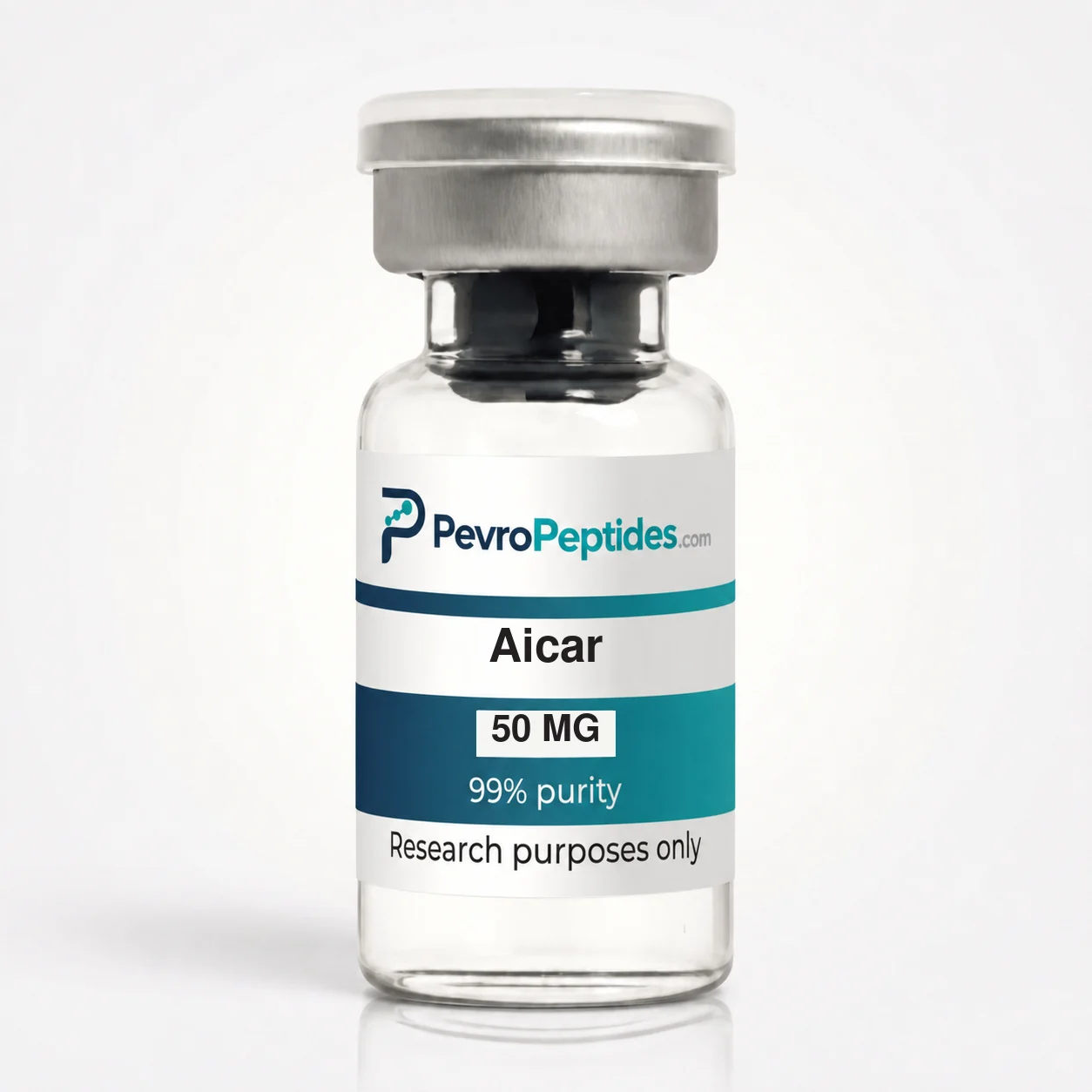
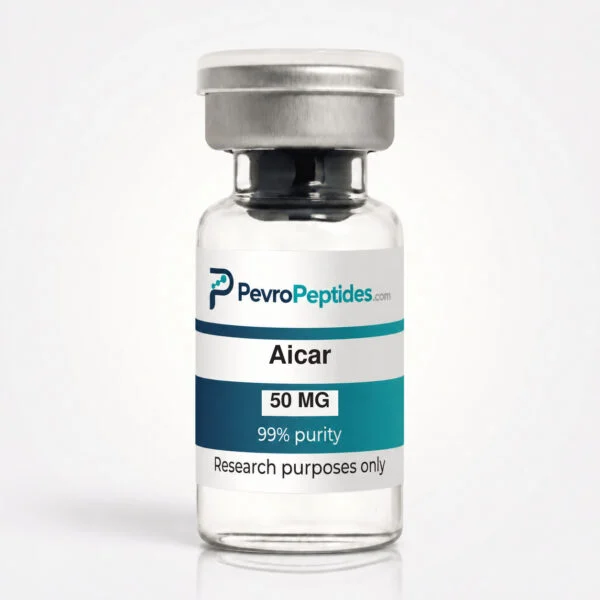
AICAR is a synthetic nucleoside analog, chemically an imidazole-4-carboxamide ribonucleoside. In scientific research, it is studied as a model compound for the biochemistry of AMP-activated protein kinase (AMPK) and as a reference standard in analytical work. This compound is offered as a freeze-dried powder of 50 mg per vial, exclusively for laboratory and research purposes.
What is AICAR?
AICAR (5-amino-1-β-D-ribofuranosylimidazole-4-carboxamide), also referred to in the literature as acadesine or AICA riboside, is a small organic molecule composed of an imidazole-4-carboxamide core coupled to a ribose unit. This structure formally makes it a nucleoside analog: the structure mimics the ribonucleoside architecture of natural purine building blocks but differs in the heterocyclic head. This combination—recognizable to nucleoside transporters and kinases, but with a different base group—makes the compound a widely used model in the study of nucleotide metabolism and kinase regulation.
In research models, AICAR itself serves as the starting compound: in cell models, it is taken up via nucleoside transporters and phosphorylated by adenosine kinase to the corresponding ribonucleotide, referred to in the literature as ZMP. This nucleotide is structurally related to AMP and is therefore described as an AMP mimetic: in vitro, it binds to the γ-subunit of AMPK and allosterically shifts the enzyme to its active conformation, without changing the intracellular AMP/ATP ratio itself. This two-step conversion makes the compound interesting for enzymological and kinase-oriented laboratory research. Consequently, AICAR is used as a model compound and reference substance within scientific research.
Research areas
In a laboratory context, AICAR occurs in the following research areas, among others:
- Enzymological research into the allosteric regulation of AMP-activated protein kinase and the role of the nucleotide-binding γ-subunit in vitro.
- Research into the phosphorylation of AICAR by adenosine kinase and the formation and degradation of the ZMP nucleotide in cell models.
- Studies into de novo purine biosynthesis, in which the AICAR ribonucleotide is a natural intermediate of the pathway.
- Model studies of downstream phosphorylation substrates of AMPK, such as acetyl-CoA carboxylase, which serves as a readout parameter for kinase activity in cell culture systems.
- Analytical method development and validation (HPLC, LC-MS) using AICAR as the reference standard for nucleoside analogs.
- Stability and solubility studies of freeze-dried nucleoside analogues under controlled conditions.
Each of these applications involves controlled laboratory or preclinical model research.
AICAR within our research range
Within our product range, AICAR falls under the category of freeze-dried investigational compounds in vial form. Researchers working with this category frequently combine the compound with other lyophilized substances that are studied via their own biochemical target. While AICAR focuses on a nucleotide-gated kinase system, other components within the same product line have been selected to cover receptor-bound or peptide-mediated targets. These compounds share the freeze-dried vial form but differ fundamentally in molecular class and investigated mechanism.
Specifications
| Specification | Value |
|---|
| Sample | AICAR |
| Synonyms | Acadesine; AICA riboside; 5-amino-1-β-D-ribofuranosylimidazole-4-carboxamide; GP-1-110; NSC-105823 |
| CAS number | 2627-69-2 |
| Molecular formula / weight | C9H14N4O5 / 258.23 Da |
| PubChem CID | 17513 |
| Class | Small molecule, nucleoside analog (non-peptide) |
| Form | Freeze-dried powder in vial |
| Quantity per vial | 50 mg |
| Storage | Keep refrigerated, protected from light and moisture |
Shape, handling and storage
AICAR is supplied as a freeze-dried powder with a standardized quantity of 50 mg per vial, sealed under a rubber stopper with an aluminium closure. Unlike a solid tablet form, this lyophilisate is dissolved in a suitable solvent in a laboratory setting before analytical or mechanical work takes place; the freeze-dried state primarily serves to ensure stability during storage and transport.
Store the vial refrigerated, protected from direct light and moisture, in the original packaging. Handle the compound with standard laboratory precautions: work in a clean environment, use appropriate personal protective equipment, and prevent cross-contamination with other research materials. Keep the packaging out of reach of unauthorized persons.
Composition and lab results
For this compound, a controlled purity of ≥ 99% (HPLC) is maintained, as is customary for freeze-dried compounds in vial form. The vial contains a single lyophilisate without added excipients.
You can find an overview of the available analytical documentation on our lab results pageThe reports are collected centrally there, so that you can incorporate the data into your own research records.
Frequently Asked Questions
To which class of substances does AICAR belong?
AICAR is a small synthetic molecule of the class of nucleoside analogs, composed of an imidazole-4-carboxamide core and a ribose unit. It is not a peptide and therefore contains no amino acid sequence.
What is the role of ZMP in research?
In cell models, AICAR is phosphorylated by adenosine kinase to the ribonucleotide ZMP. This nucleotide is structurally similar to AMP and is therefore considered an AMP mimetic; it is a central focus in mechanistic research into allosteric activation of AMPK in vitro.
In what form is the compound supplied?
As a freeze-dried powder of 50 mg in a sealed vial, intended to be dissolved in a suitable solvent before analytical use.
How do I store the vial?
Refrigerated, protected from light and moisture, preferably unopened in the original packaging and without repeated temperature changes.

















 Pick up from the Woodmart Store
 Courier delivery
 DHL Courier delivery



Reviews
There are no reviews yet.