















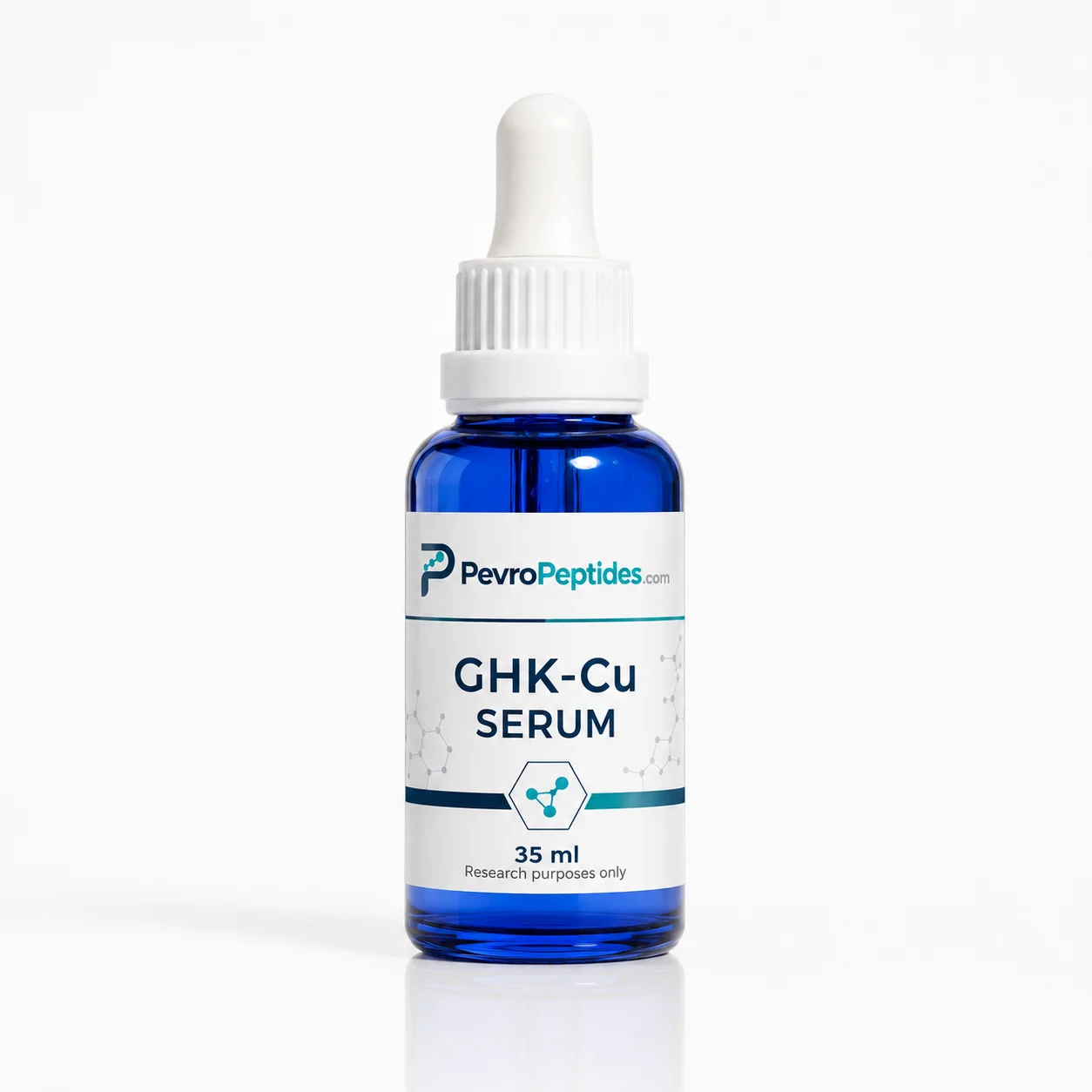
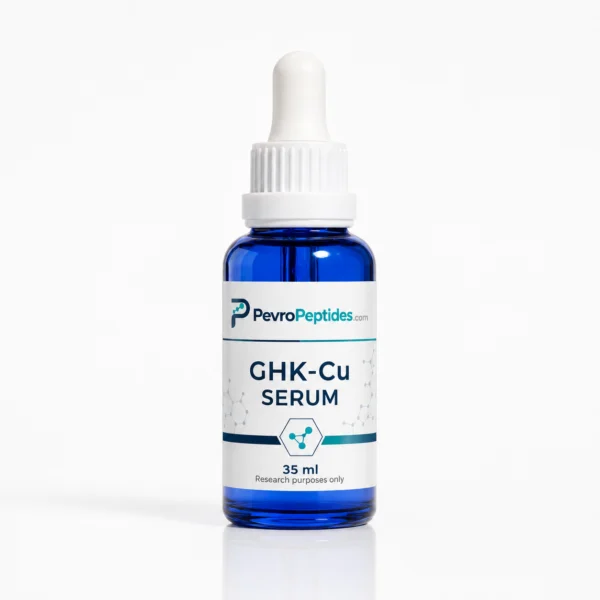
GHK-Cu Serum 35 ml
-
 Abholung im Woodmart-Laden
Heute abholen
Frei
-
 Kurierzustellung
Unser Kurier liefert an die angegebene Adresse.
2-3 Tage
Ab 40 $
-
 DHL-Kurierdienst
Der DHL-Kurier liefert an die angegebene Adresse.
1-2 Tage
Ab 40 $
Topical investigation serum formulated with GHK-Cu (Glycyl-L-Histidyl-L-Lysine + copper ion complex), a naturally occurring tripeptide-copper complex that is classically studied in dermatological models involving collagen synthesis, tissue repair, and gene expression of extracellular matrix components.
€ 64,95
Levering en betaling
Levering is beschikbaar in de Europese Unie, het Verenigd Koninkrijk en de Verenigde Staten. De exacte diensten en kosten voor het adres worden bij het afrekenen bevestigd.
- 1AdresVul de bestemming in
- 2LeveringControleer de dienst en kosten
- 3BetalingKies een ingeschakelde methode

Levering
Bestemmingen: Europese Unie, Verenigd Koninkrijk en Verenigde Staten.
Leveringsinstellingen worden ingerichtEr is nog geen leveringsdienst ingeschakeld. Beschikbare diensten en kosten verschijnen hier zodra de winkelinstellingen zijn voltooid.

Betaling
Kaartbetaling, cryptovaluta, bankoverschrijving of andere methoden verschijnen pas wanneer ze zijn ingeschakeld en beschikbaar zijn voor deze bestelling.
Beschreibung
GHK-Cu Serum 35 ml is an aqueous research formulation based on a copper-binding tripeptide, chemically a metallopeptide of glycyl-L-histidyl-L-lysine with a coordinated copper(II) ion. In scientific research, this compound is studied as a model compound for the coordination chemistry of peptide-metal complexes and as a reference standard in analytical work. The product is offered as a ready-to-use aqueous formulation of 35 ml, exclusively for laboratory and research purposes.
Was ist GHK-Cu?
GHK-Cu is the copper(II) complex of the naturally occurring tripeptide GHK, with the amino acid sequence glycine-histidine-lysine (Gly-His-Lys). The metal ion is fixed in a defined coordination pocket: the bonding mode is typically described as a planar arrangement of three nitrogen donors, namely the α-amino group of the N-terminal glycine, the deprotonated amide nitrogen atom of the first peptide bond, and the imidazole of the histidine. The basic lysine side chain remains outside this arrangement and keeps the complex highly water-soluble. Because this geometry is sharply defined, GHK-Cu is considered a classic model system for copper binding to short peptides in bioinorganic chemistry.
In research models, the complex is primarily studied as an exchangeable copper reservoir: in vitro, under defined conditions, the coordinated ion can be transferred to competing ligands or to copper-dependent enzymes such as lysyl oxidase and superoxide dismutase. Additionally, the copper(II) center makes the formulation easy to monitor spectroscopically: alongside the UV absorption of the imidazole, a weak dd transition occurs in the visible region, which explains the blue color and makes the integrity of the complex measurable. In cell-free systems and fibroblast cultures, the redox balance around the coordinated ion is further investigated. Consequently, GHK-Cu is used as a model compound and reference substance within scientific research.
Forschungsgebiete
Im Laborkontext tritt GHK-Cu unter anderem in folgenden Forschungsbereichen auf:
- Bioanorganische Koordinationschemie: Stabilitätskonstanten, Stöchiometrie und Geometrie von Kupfer(II)-Peptid-Komplexen.
- Enzymologische Untersuchungen an kupferabhängigen Enzymen, einschließlich Lysyloxidase und Superoxiddismutase, in zellfreien Systemen.
- Zellkulturmodelle zur Umwandlung von Komponenten der extrazellulären Matrix in Fibroblastenkulturen.
- Formulation research into metallopeptides in an aqueous matrix, including pH-dependent complex stability.
- Analytical method development and validation (HPLC, UV-vis, LC-MS) with the formulation as reference material.
- Stability and permeation studies on membrane models under controlled light and temperature conditions.
Jede dieser Anwendungen beinhaltet kontrollierte Labor- oder präklinische Modellforschung.
GHK-Cu Serum in our research assortment
Within our range, this product falls under the category of ready-to-use aqueous investigational formulations in vial form. While this formulation focuses on metal coordination and the associated bioinorganic chemistry, other components within the same product line have been specifically chosen to cover peptide-receptor interactions or enzymatically mediated targets. These products share the aqueous serum base and vial packaging, but differ fundamentally in molecular class and investigated mechanism.
Spezifikationen
| Spezifikation | Wert |
|---|---|
| Probe | GHK-Cu (Glycyl-L-Histidyl-L-Lysin, Kupfer(II)-Komplex) |
| Synonyme | Kupfertripeptid-1; Cu-GHK |
| Sequenz | Gly-His-Lys |
| CAS-Nummer | 89030-95-5 (Kupfer(II)-Komplex) 49557-75-7 (GHK-Peptid) |
| Molekularformel / Gewicht (GHK-Peptid) | C14H24N6O4 / 340,38 Da |
| PubChem CID | 378611 (Cu-GHK) 342538 (GHK) |
| Klasse | Metallopeptid; Kupfer(II)-Komplex eines Tripeptids |
| Bilden | Aqueous serum with preservative |
| Contents per bottle | 35 ml |
| Lagerung | Keep cool, protected from direct light |
Form, Handhabung und Lagerung
The product is supplied as a ready-to-use aqueous formulation of 35 ml in a vial. No solid needs to be weighed: the active substance is already stabilized in the matrix, together with a preservative that inhibits microbial growth. The liquid has the blue tint characteristic of copper(II) peptides, which comes from the coordinated metal ion. In a research setting, the formulation is applied to model substrates, tissue models, or cell culture preparations in accordance with the applicable laboratory protocol.
Store the vial in a cool, protected place away from direct light, and keep it tightly closed when not in use. Copper(II) complexes are sensitive to light and oxidative conditions, more so in aqueous matrix than in dry form. Handle the product with standard laboratory precautions: work in a clean environment, use appropriate personal protective equipment, and prevent cross-contamination. Keep the packaging out of reach of unauthorized persons.
Zusammensetzung und Laborergebnisse
The GHK-Cu active ingredient in this formulation is offered with a controlled purity of ≥ 99% (HPLC). That figure refers to the processed metallopeptide and not to the preparation as a whole; the exact active ingredient concentration is available upon request.
Eine Übersicht der verfügbaren Analysedokumentation finden Sie auf unserer Website. Seite mit Laborergebnissen, wo die Berichte zentral gesammelt werden.
Häufig gestellte Fragen
Zu welcher Stoffklasse gehört GHK-Cu?
A metallopeptide: the tripeptide Gly-His-Lys with one coordinated copper(II) ion. Therefore, neither a pure peptide nor an inorganic copper salt.
Welche Rolle spielt das Kupferion im untersuchten Mechanismus?
Es wird durch die N-terminale Aminogruppe, das Amid-Stickstoffatom der ersten Peptidbindung und das Imidazol des Histidins stabilisiert. Diese Geometrie bestimmt die Bindungsstärke und liefert die dd-Absorptionsbande für die spektroskopische Kontrolle.
In what form is this product delivered?
As a ready-to-use aqueous formulation of 35 ml with preservative, in a bottle.
How do I store the bottle?
Cool and protected from direct light, tightly closed when not in use.


Rezensionen
Es gibt noch keine Rezensionen.