Numai pentru uz de laborator și cercetare. Nu este destinat uzului uman sau veterinar.
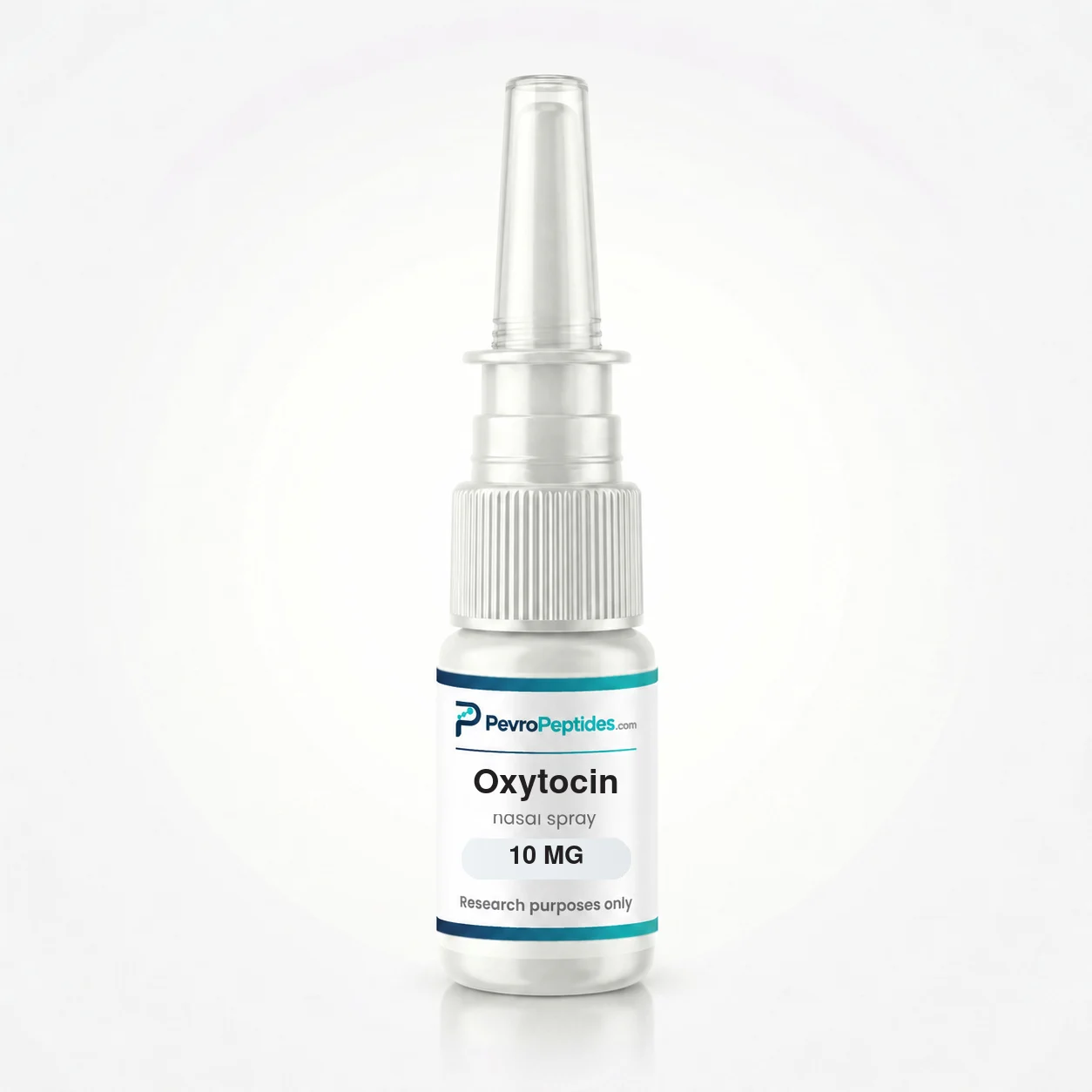
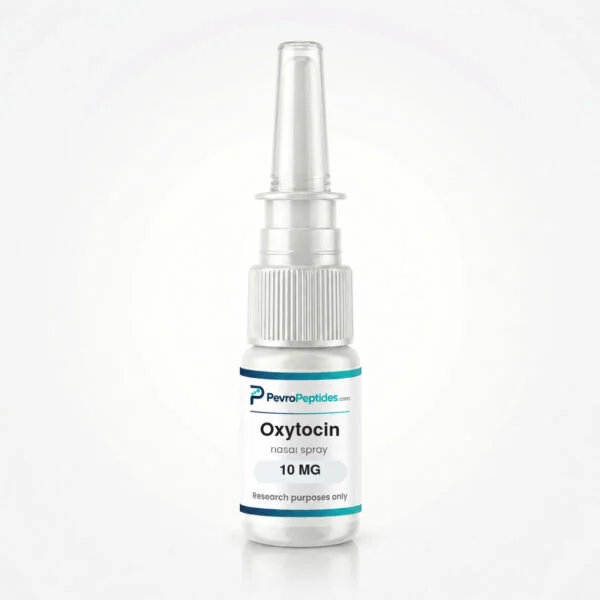
Oxytocin is a cyclic nonapeptide that is studied in controlled laboratory settings within the framework of peptide-mediated signaling pathways, receptor interaction modeling, and molecular regulatory systems. Due to its defined molecular profile, it also serves as a reference standard in analytical work. This research material is offered as freeze-dried lyophilisate in a sealed 10 mg vial, supplied as a kit with an accompanying spray bottle.
What is Oxytocin?
Oxytocin is a peptide composed of nine amino acid residues, with the sequence Cys-Tyr-Ile-Gln-Asn-Cys-Pro-Leu-Gly-NH2. Between the cysteine residues at positions 1 and 6 lies a disulfide bridge that forms the first six residues into a closed ring; the remaining tripeptide (Pro-Leu-Gly-NH2) protrudes from there as a tail and ends in an amidated C-terminus. This combination of a fixed ring and a flexible tail makes oxytocin a widely used model system in the study of cyclic peptides and the influence of disulfide bridges on conformation and stability. Structurally, the compound belongs to the neurohypophyseal nonapeptides.
In research models, oxytocin is studied in relation to the oxytocin receptor (OXTR), a class A G-protein-coupled receptor. In cell models, it is described that receptor binding couples to Gq/11-proteins initiates, after which phospholipase C the membrane phospholipid PIP2 splits into inositol triphosphate (IP3) and diacylglycerol (DAG) — second messengers associated in vitro with the mobilization of intracellular calcium. In the literature, this cascade model serves as a framework to describe signal transduction in cell models. Consequently, oxytocin is used as a model compound and reference substance in scientific research.
Domenii de cercetare
In a laboratory context, oxytocin occurs in the following research areas, among others:
- Research into receptor interaction and binding kinetics of cyclic nonapeptides to G-protein-coupled receptors in vitro.
- Studies on peptide-mediated signaling pathways and intracellular regulatory networks in controlled cell models.
- Structure-activity relationship study into the contribution of individual amino acid residues within the ring structure.
- Conformation and stability research into the role of the disulfide bridge in the spatial structure of short peptides.
- Analytical method development and validation (HPLC, LC-MS, UV spectrometry) using oxytocin as the reference standard.
- Comparative study within the class of neurohypophyseal nonapeptides under controlled conditions.
Fiecare dintre aceste aplicații implică cercetare controlată de laborator sau pe modele preclinice.
Specificație analitică
The material is submitted with a controlled purity of ≥ 99%, determined via high-pressure liquid chromatography (HPLC). Identity and purity are determining parameters in analytical peptide work: impurities or degradation products distort the interpretation of measurement results, and in the case of a disulfide-containing peptide, the integrity of the bridge itself is a contributing factor to the measured identity. An overview of the available analysis documentation can be found on our website. pagina cu rezultate de laborator.
Specificații
| Specificații | Valoare |
|---|
| Eşantion | Oxytocin |
| Sinonime | Oxytocin; ocytocin; α-hypofamine |
| Secvenţă | Cys-Tyr-Ile-Gln-Asn-Cys-Pro-Leu-Gly-NH2 (cyclic, 1–6 disulfide) |
| Număr CAS | 50-56-6 |
| Formula moleculară / greutate | C43H66N12O12S2 / ± 1007.2 Da |
| ID-ul PubChem | 439302 |
| Clasă | Cyclic nonapeptide (neurohypophyseal peptide family) |
| Formă | Freeze-dried lyophilisate in sealed vial, with spray bottle |
| Cantitate per flacon | 10 mg |
| Puritate | ≥ 99% (HPLC) |
| Depozitare | A se păstra într-un loc răcoros și întunecat, ferit de lumină și umiditate. |
Formă, manipulare și depozitare
Oxytocin is supplied as freeze-dried lyophilisate in a sealed 10 mg vial, together with a spray bottle. The lyophilization process preserves the molecular integrity of the peptide during storage and transport. The material is a white to off-white powder or a compact cake; both appearances are normal. The lyophilisate is brought into solution prior to analytical work.
Store the sealed lyophilisate in a cool, dry, and dark place in the original packaging, protected from light and moisture. Observe the compound with standard laboratory precautions: work in a clean environment, use appropriate personal protective equipment, avoid repeated temperature changes, and keep the packaging out of reach of unauthorized persons. Dispose of residual material in accordance with applicable laboratory guidelines.
Oxytocin in our research range
Oxytocin falls under the category of freeze-dried investigational compounds in vial form within our product range. While oxytocin distinguishes itself through its disulfide-stabilized ring structure and associated receptor-mediated signal transduction, other components within the same product line have been specifically selected to cover enzymatic or metal-based targets. These compounds share the freeze-dried vial form but differ fundamentally in molecular class and investigated mechanism.
Întrebări frecvente
To which class of substances does oxytocin belong?
Oxytocin is a cyclic nonapeptide and belongs to the neurohypophyseal peptides, to which vasopressin is also classified.
Why is the disulfide bridge relevant in research?
The bridge between the cysteine residues at positions 1 and 6 encloses the first six residues into a ring and largely determines the spatial structure. This defined conformation makes the molecule highly characterizable and thus useful as a reference in analytical methods.
Sub ce formă este furnizat compusul?
As freeze-dried lyophilisate in a sealed 10 mg vial with a purity of ≥ 99% (HPLC), together with a spray bottle.
What color is the material?
White to off-white; the lyophilisate can be in the vial as a loose powder or as a compact cake.
Cum depozitez materialul?
Store in a cool, dry, and dark place in the original packaging, protected from light and moisture.

















 Ridicare din magazinul Woodmart
 Livrare prin curier
 Livrare prin curier DHL



Recenzii
Nu există recenzii până acum.