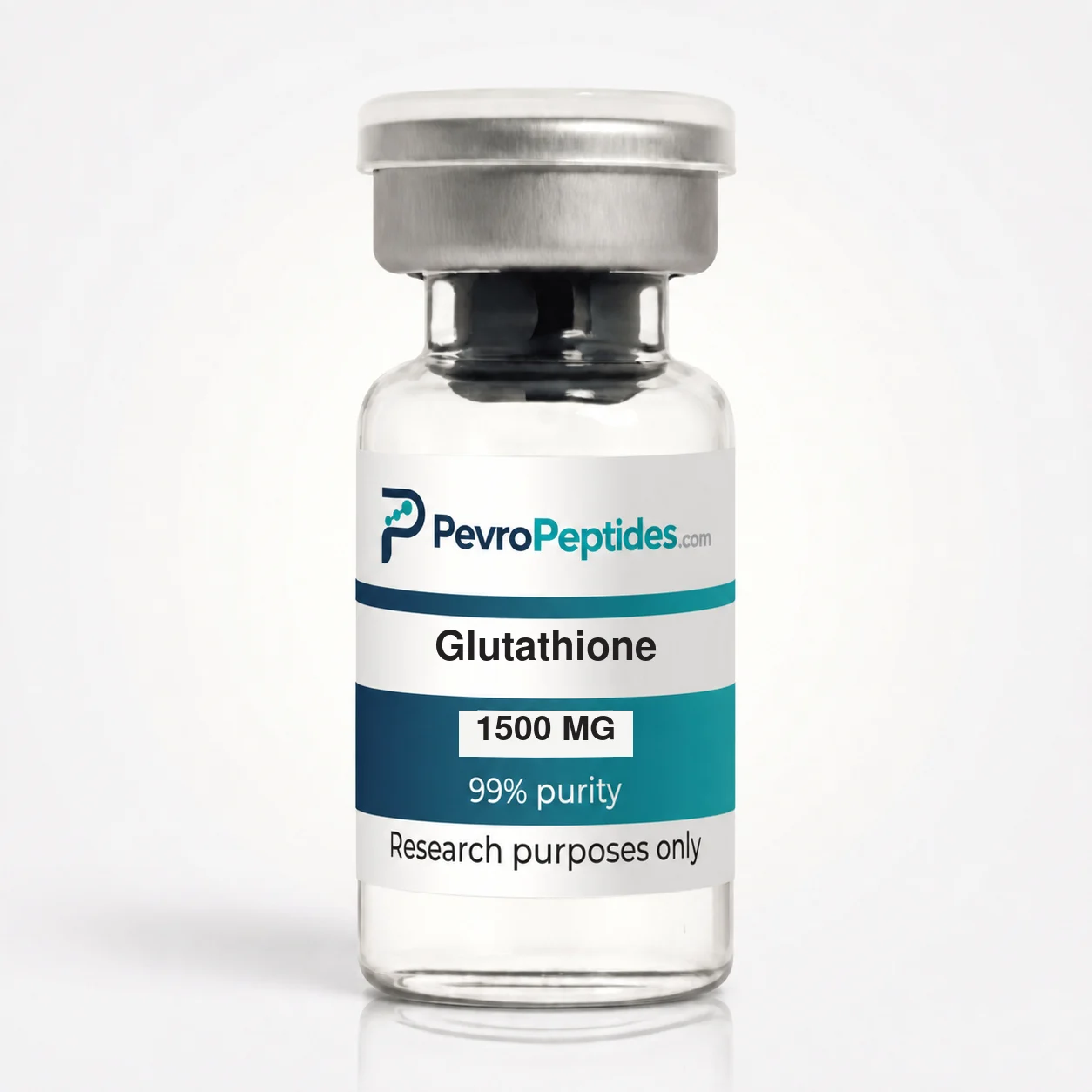
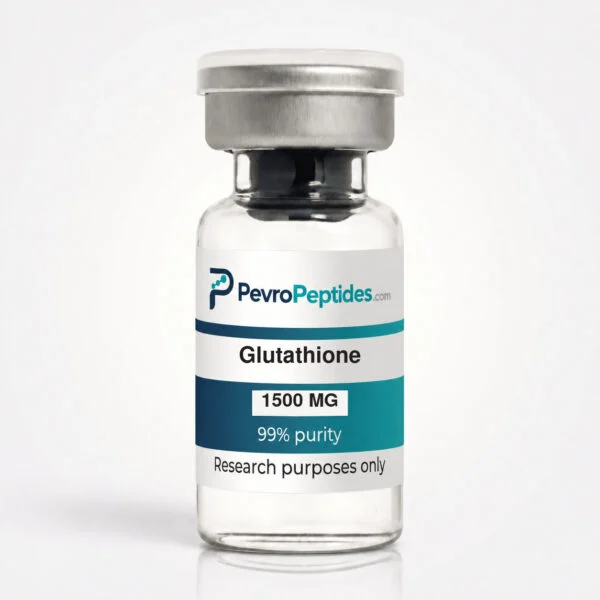
Glutathione (GSH) is a naturally occurring tripeptide, chemically a thiol-containing γ-glutamyl peptide. In scientific research, it is studied as a model compound for redox biochemistry and enzymology and as a reference standard in analytical work. This compound is offered as a freeze-dried powder of 1500 mg per vial, exclusively for laboratory and research purposes.
What is glutathione?
Glutathione (γ-L-glutamyl-L-cysteinyl-glycine) is a tripeptide composed of the amino acids glutamic acid, cysteine, and glycine, with the sequence γ-Glu-Cys-Gly. It is characterized by an unusual γ-peptide bond: the glutamate residue is linked to cysteine via its side chain rather than the α-carboxyl group, making the molecule resistant to most common aminopeptidases. The free thiol group of the cysteine residue forms the reactive core. It is precisely this combination of an atypical peptide bond and a free sulfhydryl that makes glutathione a widely used model molecule in peptide chemistry and thiol biochemistry.
In research models, the compound plays a central role in the GSH/GSSG redox couple: in vitro, two GSH molecules can form a disulfide bridge to the oxidized dimer GSSG, which is then converted back to the reduced form by NADPH-dependent glutathione reductase. Additionally, in cell models, glutathione acts as a cofactor for glutathione peroxidases and as a substrate for glutathione S-transferases, which couple the thiol group to nonpolar electrophiles. Biosynthesis proceeds in two ATP-dependent steps via glutamate cysteine ligase and glutathione synthetase, together forming the core of the γ-glutamyl cycle. Consequently, glutathione is used as a model compound and reference substance in scientific research.
Research areas
In a laboratory context, glutathione occurs in the following research areas, among others:
- Enzymological investigation of glutathione peroxidases, glutathione reductase, and glutathione S-transferases and their substrate specificity in vitro.
- Model studies of the GSH/GSSG redox couple and the determination of the intracellular redox potential in isolated cell culture systems.
- Research into S-glutathionylation of cysteine residues in proteins as a post-translational modification in cell models.
- Biochemical studies on the γ-glutamyl cycle, glutamate-cysteine ligase and the kinetics of two-step biosynthesis.
- Analytical method development and validation (HPLC, LC-MS, thiol varitization) using glutathione as the reference standard.
- Stability and solubility studies of thiol-containing peptides and their oxidation behavior under controlled conditions.
Each of these applications involves controlled laboratory or preclinical model research.
Glutathione in our research assortment
Glutathione falls under the category of freeze-dried research peptides in vial form within our range. Researchers working with this category frequently combine the compound with other peptides studied via their own biochemical targets. While Glutathione focuses on thiol chemistry and redox-dependent enzyme systems, other components within the same product line have been specifically chosen to cover receptor-linked or signal-mediated targets. These compounds share the freeze-dried vial form but differ fundamentally in amino acid composition and investigated mechanism.
Specifications
| Specification | Value |
|---|
| Sample | Glutathione (GSH) |
| Synonyms | γ-L-glutamyl-L-cysteinyl-glycine; L-glutathione (reduced); γ-Glu-Cys-Gly |
| CAS number | 70-18-8 |
| Molecular formula / weight | C10H17N3O6S / 307.33 Da |
| PubChem CID | 124886 |
| Class | Tripeptide, thiol-containing γ-glutamyl peptide |
| Form | Lyophilisate (freeze-dried powder) |
| Quantity per vial | 1500 mg |
| Storage | Keep refrigerated, protected from light and moisture |
Shape, handling and storage
Glutathione is supplied as a freeze-dried powder in a sealed glass vial containing a standardized quantity of 1500 mg. Unlike a solid tablet form, this lyophilisate is intended to be dissolved in a suitable solvent in a laboratory setup before analytical work takes place. The free thiol group is susceptible to oxidation to GSSG in solution; therefore, the compound is offered in freeze-dried form.
Store the vial refrigerated, protected from direct light and moisture, in the original packaging and with the seal intact. Handle the connection with standard laboratory precautions: work in a clean environment, use appropriate personal protective equipment, and prevent cross-contamination with other research materials. Avoid repeated temperature changes and keep the packaging out of reach of unauthorized persons.
Composition and lab results
The lyophilisate contains glutathione with a controlled purity of ≥ 99% (HPLC). The vial contains exclusively the freeze-dried compound, without added excipients or preservatives.
You can find an overview of the available analytical documentation on our lab results pageThe reports are collected centrally there, so that you can incorporate the data into your own research records.
Frequently Asked Questions
To which class of substances does glutathione belong?
Glutathione is a tripeptide composed of glutamic acid, cysteine, and glycine. Due to the γ-peptide bond between glutamate and cysteine, it is classified as a γ-glutamyl peptide and not as an ordinary linear peptide.
What is the difference between GSH and GSSG in research?
GSH is the reduced form with a free thiol group; GSSG is the oxidized dimer in which two molecules are linked via a disulfide bridge. The ratio of both forms is used in cell models as a measure of the redox state.
In what form is the compound supplied?
As a freeze-dried powder in a sealed vial with 1500 mg per unit. The lyophilized form limits oxidation of the thiol group during storage and transport.
How do I store the vial?
Refrigerated, protected from light and moisture, preferably in the original packaging with the seal intact.

















 Pick up from the Woodmart Store
 Courier delivery
 DHL Courier delivery



Reviews
There are no reviews yet.