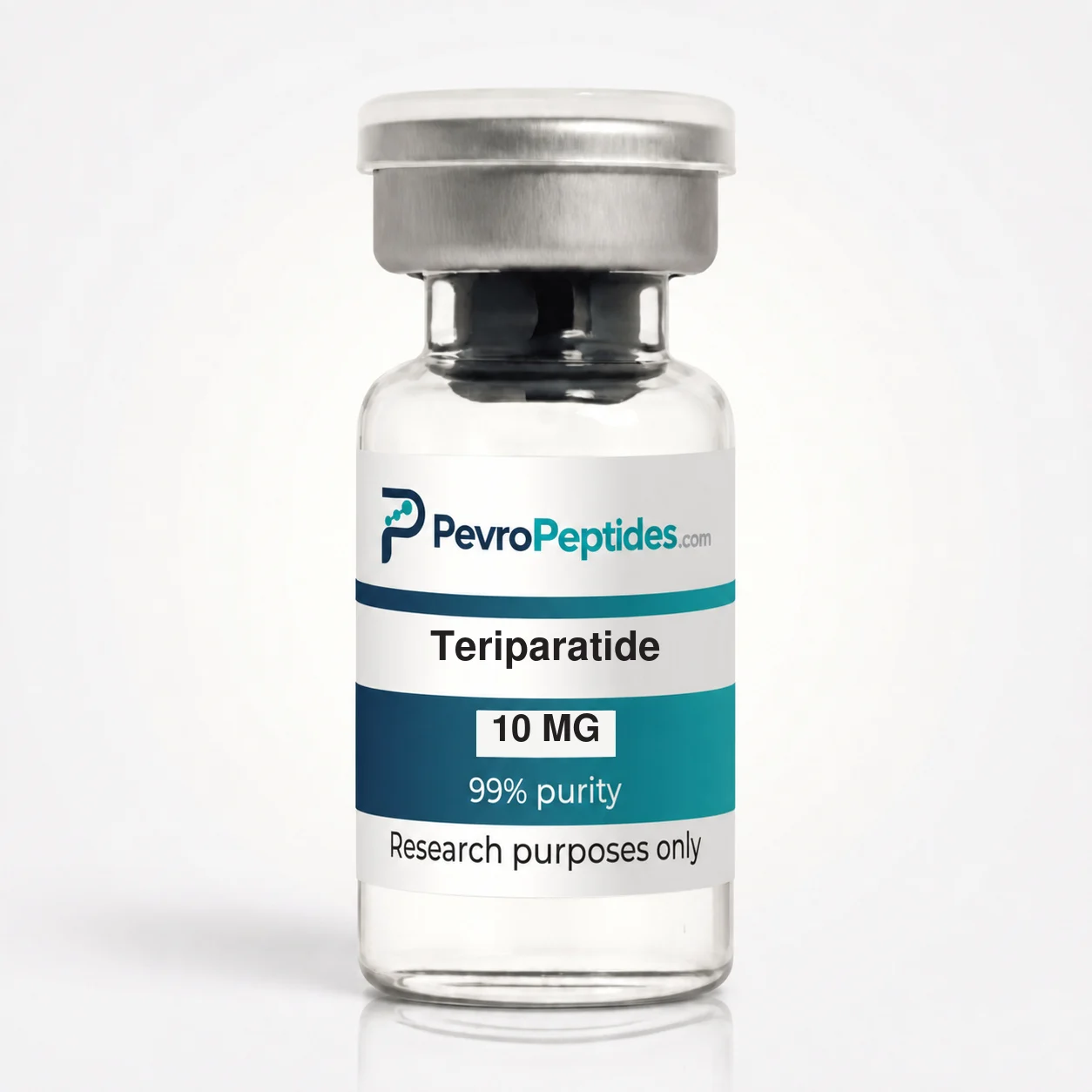
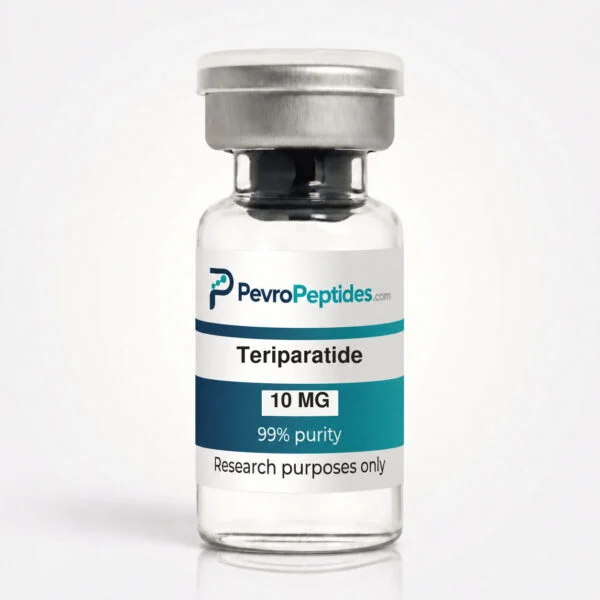
Teriparatide is a 34-amino acid polypeptide, chemically the N-terminal fragment 1-34 of human parathyroid hormone. In scientific research, it is studied as a model compound for the activation of class B receptors and as a reference standard in analytical and biophysical work. This compound is offered as a freeze-dried powder of 10 mg per sealed vial, exclusively for laboratory and research purposes.
What is Teriparatide?
Teriparatide, also designated as PTH(1-34) or hPTH 1-34, comprises the first 34 amino acids of the 84-amino acid parent hormone, with the sequence Ser-Val-Ser-Glu-Ile-Gln-Leu-Met-His-Asn-Leu-Gly-Lys-His-Leu-Asn-Ser-Met-Glu-Arg-Val-Glu-Trp-Leu-Arg-Lys-Lys-Leu-Gln-Asp-Val-His-Asn-Phe. Functionally, the fragment divides into two parts: the outermost N-terminal segment determines activation, while the C-terminal part primarily determines affinity. In solution, under suitable conditions, the peptide forms two short amphipathic helices with a flexible hinge region between them, a structure that can be easily monitored using circular dichroism and NMR. The two methionine residues at positions 8 and 18 are susceptible to oxidation, making the fragment a useful model for research into peptide degradation.
In research models, Teriparatide binds to the PTH1 receptor, a G-protein-coupled class B receptor with a large extracellular domain. According to the standard two-domain model, the C-terminal part of the peptide first binds to that extracellular domain, after which the N-terminal part slides into the transmembrane cavity and brings the receptor into an active conformation. In cell models, this leads to activation of both the Gs-cAMP pathway and the Gq-phospholipase-C pathway; the ratio between the two is a widely used starting point for research into signal selectivity. Consequently, Teriparatide is used as a model compound and reference substance within scientific research.
Research areas
In a laboratory context, Teriparatide occurs in the following research areas, among others:
- Binding and activation studies of the PTH1 receptor in cell lines and membrane preparations in vitro.
- Research into signal transduction: cAMP formation via the Gs pathway and calcium signaling via the phospholipase-C pathway in cell models.
- Research into receptor conformations and the residence time of the ligand-receptor complex.
- Structure-activity research in which fragments are shortened or residues replaced to separate both domains.
- Biophysical investigation into secondary structure and helix formation with circular dichroism, fluorescence (the tryptophan at position 23) and NMR.
- Stability and aggregation studies with attention to methionine oxidation, and analytical method development (HPLC, LC-MS) with the peptide as the reference standard.
Each of these applications involves controlled laboratory or preclinical model research.
Teriparatide in our research assortment
Teriparatide falls under the category of freeze-dried peptides in sealed vials within our product range. While Teriparatide targets a class B receptor with a large extracellular domain, other components within the same product line focus on shorter chains or enzymatic targets. They share the freeze-dried form and associated storage requirements, but differ fundamentally in chain length and investigated mechanism.
Specifications
| Specification | Value |
|---|
| Sample | Teriparatide |
| Synonyms | PTH(1-34); hPTH 1-34; parathyroid hormone fragment 1-34 |
| CAS number | 52232-67-4 |
| Molecular formula / weight | C181H291N55O51S2 / 4118 Da |
| PubChem CID | 16133850 |
| Sequence | SVSEIQLMHNLGKHLNSMERVEWLRKKLQDVHNF (34 amino acids) |
| Class | Polypeptide, hormone fragment; ligand of the PTH1 receptor |
| Form | Freeze-dried powder (lyophilisate) |
| Quantity per vial | 10 mg |
| Storage | Freeze-dried, store in a cool, dark place; in solution, refrigerated and protected from light. |
Shape, handling and storage
Teriparatide is supplied as a freeze-dried powder in a sealed vial containing 10 mg per unit. The lyophilisate is a solid, powdery to slightly spongy mass that is only brought into solution in the laboratory setup, according to the laboratory's own procedure. Peptides of this chain length are significantly more stable in solid form than in solution.
Store the unopened vial in a cool, dry, and dark place in the original packaging; avoid exposure to room temperature, moisture, and direct light. Handle the material with standard laboratory precautions: work in a clean environment, use appropriate personal protective equipment, and prevent cross-contamination with other research materials. Keep the packaging out of reach of unauthorized persons.
Composition and lab results
The material in the vial consists of the freeze-dried peptide fragment with a controlled purity of ≥ 99% (HPLC). In the case of a lyophilized product, the quality is expressed as a purity percentage, whereby chromatographic separation also reveals related chains and oxidation products.
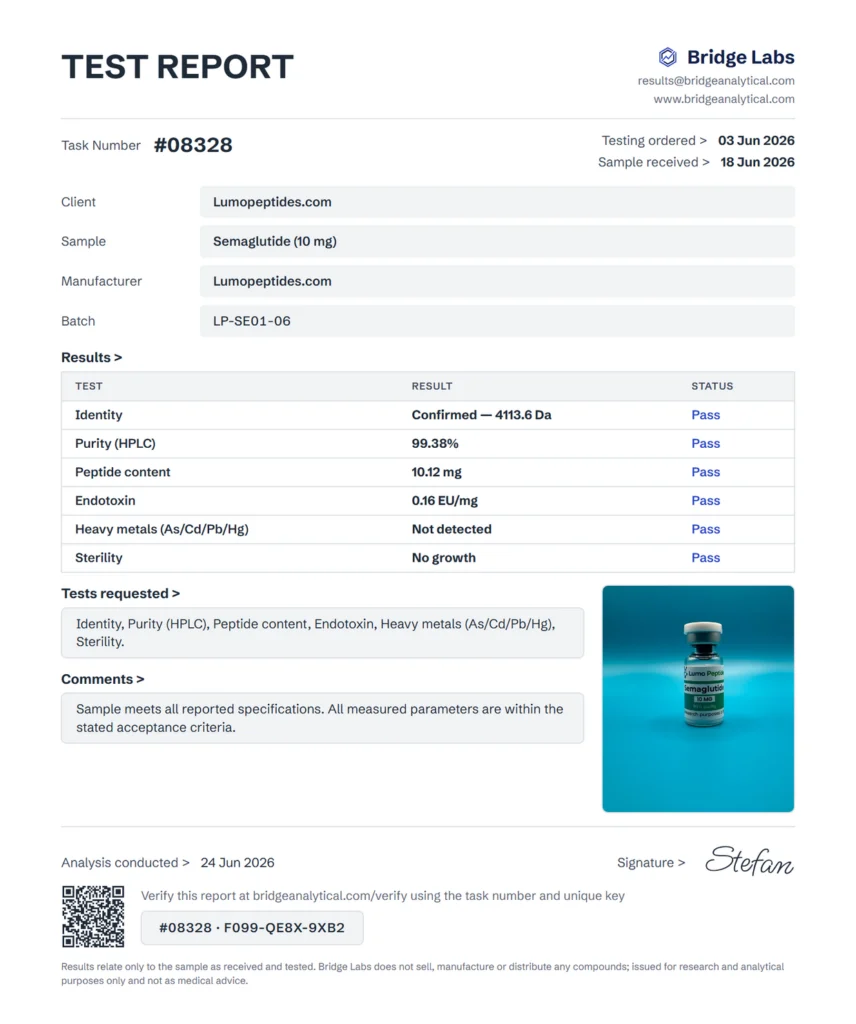
You can find an overview of the available analytical documentation on our lab results pageThe reports are collected centrally there, so that you can incorporate the data into your own research records.
Frequently Asked Questions
Which substance class does Teriparatide belong to?
Teriparatide is a polypeptide of 34 amino acids: the N-terminal fragment of an endogenous hormone with 84 residues. It is therefore not a small synthetic molecule, but a peptide chain with its own amino acid sequence.
Why has fragment 1-34 in particular been studied so extensively?
Because this fragment contains the complete information that the PTH1 receptor needs to bind and become active, while being shorter and easier to characterize than the full hormone.
In what form is the compound supplied?
As a freeze-dried powder in a sealed vial, with 10 mg peptide per vial.
How do I store the vial?
Cool, dry, and dark, in the original packaging. The freeze-dried powder is more stable than a solution; solutions should be stored refrigerated and protected from light, and preferably used for a short period.

















 Pick up from the Woodmart Store
 Courier delivery
 DHL Courier delivery



Reviews
There are no reviews yet.